

For four years now, my lower back has been the loudest part of my body. It started with a disc flare-up when I was fifty-eight, the kind where you sit down in the recliner and then have to plan the getting up. My physical therapist gave me a set of exercises, and they work, and I do them most mornings. But there are days when standing through a whole church service, or lifting a suitcase into the trunk, or driving six hours to Boise to see my grandchildren asks more of my back than exercises can answer. So I own two kinds of support. One is a simple stretchy belt from a drugstore rack. The other is the MUELLER Sports Medicine Lumbar Back Brace with Removable Pad. Both live in my closet, and they are not the same tool.
Here is the short answer before the long one. The MUELLER brace is what I wear when the day involves standing, lifting, or a long drive. Four steel springs and a removable pad give me support that stays where I put it. The stretchy belt is what I wear when the day involves sitting at my watercolor easel or in the passenger seat, and when I would rather forget I have anything on at all. It is thinner, it breathes, and it asks nothing of my attention. If you are only going to buy one, buy the one that matches the worst hour of your week, not the average one.
| MUELLER Lumbar Back Brace | Simple stretchy support belt | |
|---|---|---|
| Support structure | Four steel springs in the back panel hold firm and flex with you | One layer of elastic that squeezes but has nothing vertical in it |
| Targeted pressure | Removable pad you set over the sore spot, or take out entirely | No pad, nothing to position |
| Lifting and bending | Still working at the bottom of a lift | Rolls up toward the ribs when you bend |
| Adjusting during the day | Hook-and-loop closure, tighten or loosen without removing it | Stretch is the only adjustment there is |
| Buying the right size | Three sizes, so you measure your waist first (Regular covers 28 to 50 inches) | Usually one size that stretches to fit, nothing to measure |
| Under clothing | Springs and pad add bulk at the back | Thin enough that no one notices |
| Breathability | Neoprene and polyester hold warmth on a hot day | Thin elastic breathes better |
| Washing | Hand wash and lay flat to dry so the springs keep their shape | Goes in the wash with the towels |
| Weight | About sixteen ounces | Lighter, since there is no hardware in it |
| Best for | Standing, lifting, long drives | Sitting, light all-day reminders |
What the Simple Stretchy Belt Actually Is
It is one wide band of elastic, sometimes two, with a hook-and-loop closure you press flat against itself. There is no hardware in it. Nothing vertical, nothing rigid, no pad. What it does is squeeze your middle, and that squeeze does two genuinely useful things. It reminds you to brace your stomach muscles instead of letting your belly sag forward, and it gives a light sense of being held together. For plenty of people with a cranky back, that reminder is most of the benefit. Mine came off a drugstore rack on a Tuesday afternoon in the fall, and I wore it for the better part of a year before I tried anything else. I bought two, one for the car and one for the house, because I did not want to be without it. That is how I thought about my back then.
What it does not do is support. Elastic under tension wants to roll, and when you bend to pick something up, it rolls. The worst one was in the produce aisle, reaching for a bag of apples at the bottom of a bin. I bent, the band slid up my back, and I stood there with one hand holding the apples and the other trying to hike a strip of elastic back down under my shirt. I have hiked mine back into place at the kitchen sink too, and once in the church parking lot. I have learned to tug it into place before I squat rather than after. The stretch that makes it comfortable is the same stretch that gives way at exactly the moment you wanted it to hold.
Where it earns its keep is the long sitting. Painting at the kitchen table for two hours, riding in the passenger seat, an afternoon of paperwork and phone calls. Elastic breathes, so I am not overheated by two in the afternoon, and it is thin enough that nobody at church knows it is there. It also goes in the wash with the towels, which matters more than it should when you wear something against your skin all day.
Where Mueller Wins
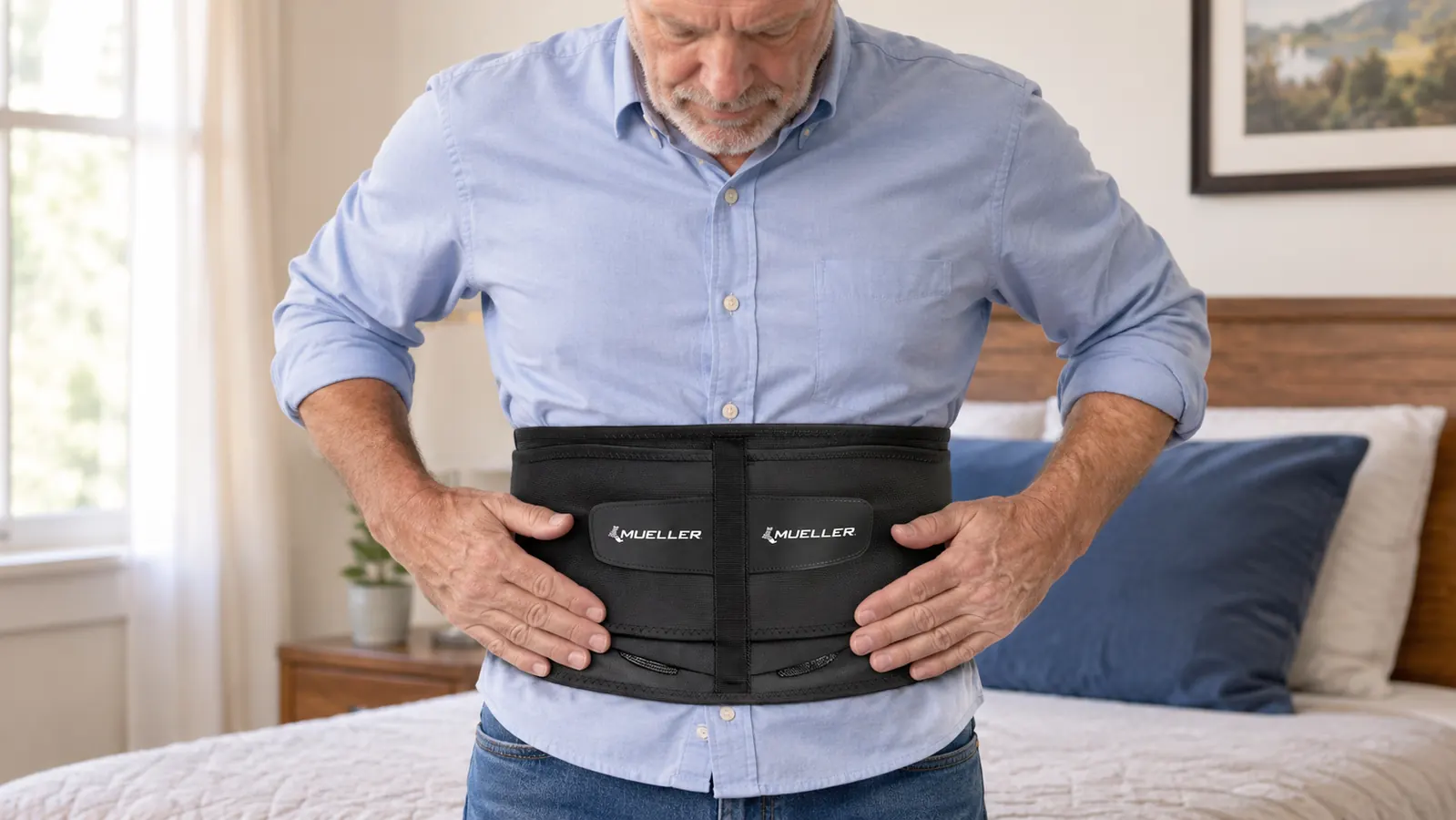
Turn the MUELLER brace over and you can feel what separates it. Four steel springs run up the back panel. They are not stiff like a board, they flex with you, but they hold their shape. When I bend to load the dishwasher or pick up a grandchild's shoe, the support is still there at the bottom of the movement. That is the whole difference in one sentence: the brace is still working at the hardest part of the bend, and the elastic belt has already climbed up around my ribs. I first noticed it on a Tuesday in March, unloading the bottom rack of the dishwasher, which is the exact move I had stopped doing without thinking about it. Nothing popped and nothing hurt. I stood up and realized I had not braced myself first, and had not needed to.
The second difference is the pad. It comes out, and it goes back wherever you want it. My pain has always been worse on the right side, so I set the pad slightly right of center and it presses where the trouble starts. On a rough morning I put it in. On a morning when that spot is already calm and I want support without pressure, I pull it out and wear the brace as a plain lumbar support. The stretchy belt cannot do either of those things because there is nothing in it to move. I keep the pad in a drawer beside the recliner, and I can tell you which mornings it goes in without checking a calendar: the mornings after I have slept on my stomach, which I know better than to do.
The third is that I can dial it in. The brace closes with hook and loop, and it lets me tighten or loosen without taking the whole thing off, so I can snug it down before I lift the laundry basket and let it out again when I sit. MUELLER sizes it by your waist measurement, not your pants size: small covers 22 to 30 inches, regular covers 28 to 50 inches, and there is a plus size. Measure around the widest part of your waist before you order, and measure honestly. I borrowed Gary's cloth tape, stood in front of the hallway mirror, and got forty-one inches, which put me in a regular, and the fit is right. Do not measure your jeans and do not measure where you wear your belt. The whole thing weighs about sixteen ounces, so it is not a burden in a suitcase, and it has ridden in mine to Boise more than once.
By the end of a six-hour drive to Boise, the elastic belt has rolled up to my ribs twice. The MUELLER brace has not moved an inch.
Where the Stretchy Belt Wins
I am not going to pretend the cheap belt has nothing going for it, because it does, and if I oversell the brace you should stop trusting me. Start with the buying. The belt is usually one size that stretches to fit, so there is no measuring, no size chart, no return envelope. You pick it up and you are done. The MUELLER requires you to find a soft tape and be honest about your waist, and if you guess, you will guess wrong. That is a real cost in hassle, and hassle is the reason a lot of good tools stay in the closet.
Then there is heat. Neoprene and polyester hold warmth, which is lovely in January and less lovely in a Spokane July. The brace is a warm thing to have wrapped around your middle, and I say that as a woman who loves a heating pad. The elastic belt is thinner and breathes, and on a hot afternoon I notice the difference by two o'clock. Last July I painted through an afternoon at the table with the fan going, and by three o'clock I had taken the brace off and hung it on the back of a chair. Under a blouse neither one shows, but I feel the brace against my back and I do not feel the belt.
And then there is laundry, and sitting. The belt goes in the wash with the towels and comes out fine. The brace gets hand washed in the bathroom sink with a little wool soap and laid flat on a towel to dry so the springs keep their shape. It takes a full day to dry, which means I think about it before I do it, and thinking about it is not the same as doing it. For a long stretch of sitting at the easel, the thin belt is simply more comfortable. When my back is annoyed but not angry, it is the one I reach for.
The brace I pack for the six-hour drive to Boise
Four steel springs, a pad you can move to the side that hurts, and a fit you can tighten without taking it off. If your worst hour is standing or lifting, this is the one I would start with.
Amazon Check Today's Price on Amazon →
How I Decide, Day by Day
Wednesday night choir rehearsal is standing, an hour and a half of it, and Sunday morning is longer. Those are brace days. So is any day with lifting: groceries, the box of watercolor paper, a suitcase. So is the drive to Boise, and I will tell you why in plain terms. Six hours in a car seat is six hours of your lower back taking a load while you sit still, and by the time I stop for gas halfway there I want something holding me that does not need adjusting. The last Wednesday in April I made a mistake and wore the belt to rehearsal, and I spent the offertory anthem standing in the third row trying to look like I was singing rather than squirming. By the second-to-last verse I had my hand flat against my lower back. Gary asked in the car afterward whether I had forgotten something at home. I had.
The other days are belt days. A Tuesday of painting, phone calls with the choir committee, an afternoon in the recliner with a book. On those days I want the reminder and nothing else. If I wake up and the right side is already complaining before I have had my coffee, I put the pad in the brace and wear that instead. It is not a difficult system. It is just honest about what each thing does.
Who Should Buy Which
Buy the MUELLER Lumbar Back Brace if your bad hours come from standing, lifting, or traveling. If your work or your hobbies keep you on your feet, if you lift grandchildren or luggage, if you spend a day in a car several times a year, the springs and the pad are the parts that will actually help you. Order it by a waist measurement. Plan on hand washing it. And if you have never worn a lumbar support, wear it around the house for an hour first, because the first time you put on a firmer brace it feels like a lot of belt. I wore mine through a whole Saturday of ordinary housework before I trusted it on a drive.
Buy the simple stretchy belt if you mostly sit, if you run warm, if you want something you can put on without thinking and wash without ceremony, or if you are not sure yet whether a support will help at all. It is a reasonable first step, and it is a reasonable second tool to keep in the drawer next to the brace. What I would not do is expect a strip of elastic to carry a day of lifting. That is not what it is for, and blaming it for that is like blaming a spoon for not cutting bread.
One more thing, and I mean it. I am a retired art teacher, not a doctor. If your pain is new, or sharp, or getting worse, or if it comes with numbness or weakness down a leg, put the belts down and call your doctor or your physical therapist. A support is a tool for a back that has already been looked at, not a substitute for having it looked at.
Start with the tool that matches your worst hour
Measure around the widest part of your waist before you order. Regular covers 28 to 50 inches, and the pad comes out if you only want the support without the pressure.
Amazon See the MUELLER Lumbar Brace on Amazon →