

The first cold snap in Spokane shows up before I am ready for it. Last October I was awake at five, waiting for the furnace to catch up with the house, and my lower back had that old grip on the right side. I have had it since a disc flare-up at fifty-eight. I have tried the rice sock, the microwave heat wrap that goes cold in eleven minutes, and the patches that smell like a drugstore aisle. The thing I keep plugging in, all season long, is a Sunbeam Heating Pad XL.
I am sixty-three, a retired elementary school art teacher, and I am not a doctor. What follows is one woman's winter with one product in one house, not medical advice. If your back pain is new, severe, or getting worse, call your doctor or your physical therapist before you buy anything at all. Mine has been guided by a physical therapist and has never needed surgery, and heat is one of the few things that lets me sit through an evening without shifting every four minutes. Here is what a full season with the Sunbeam XL actually looked like.
The Quick Verdict
Big enough to cover my whole low back, four settings that genuinely differ from one another, and a shutoff I trust enough to close my eyes. The wall outlet keeps it in one room and the two-hour cutoff always lands mid-chapter. I plug it in most nights anyway.
Amazon Check Today's Price →The pad that lived on my recliner from October to March
Twelve by twenty-four inches, four heat settings with push-button control, a two-hour auto shutoff, and a five-year limited warranty.
Amazon Check Today's Price on Amazon →How I've Used It
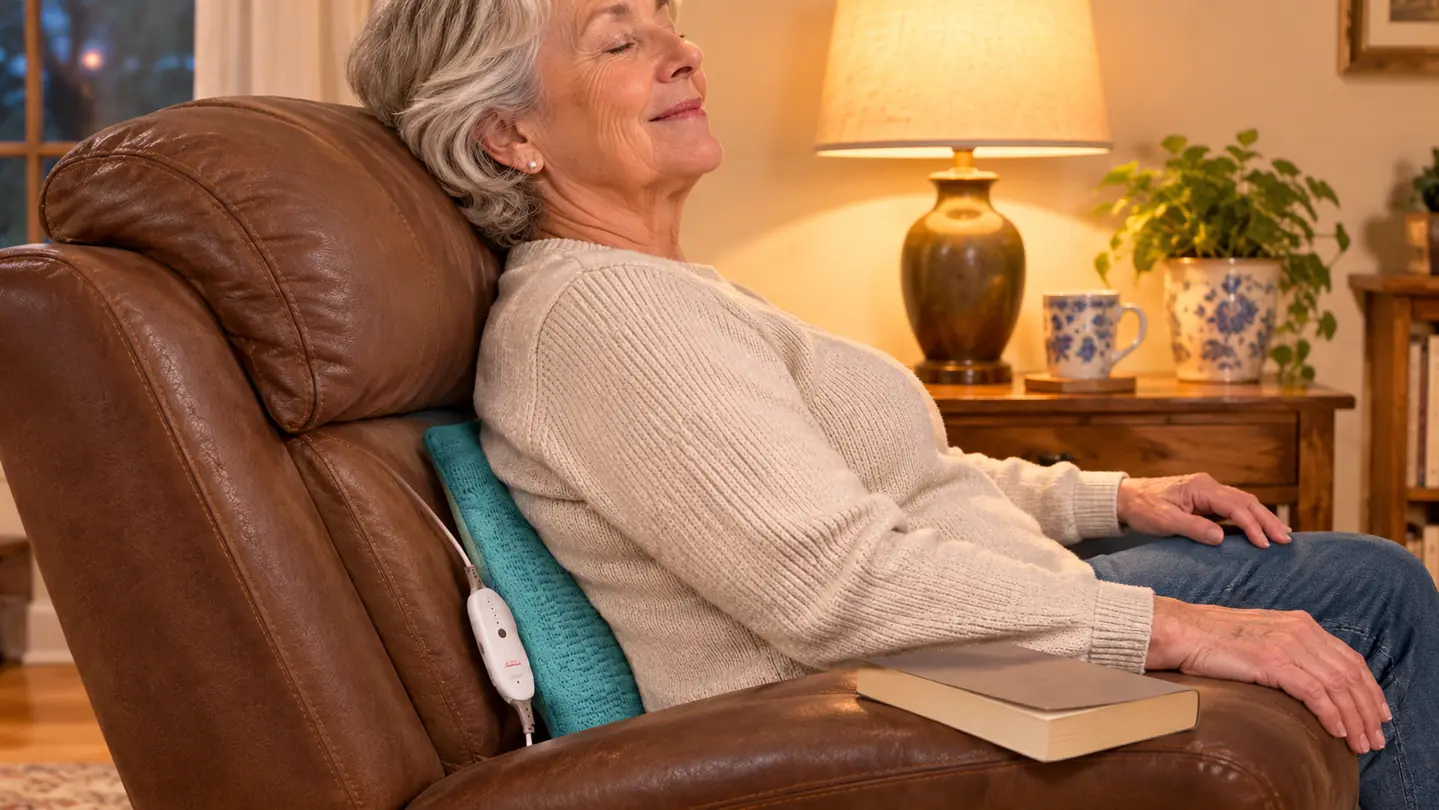
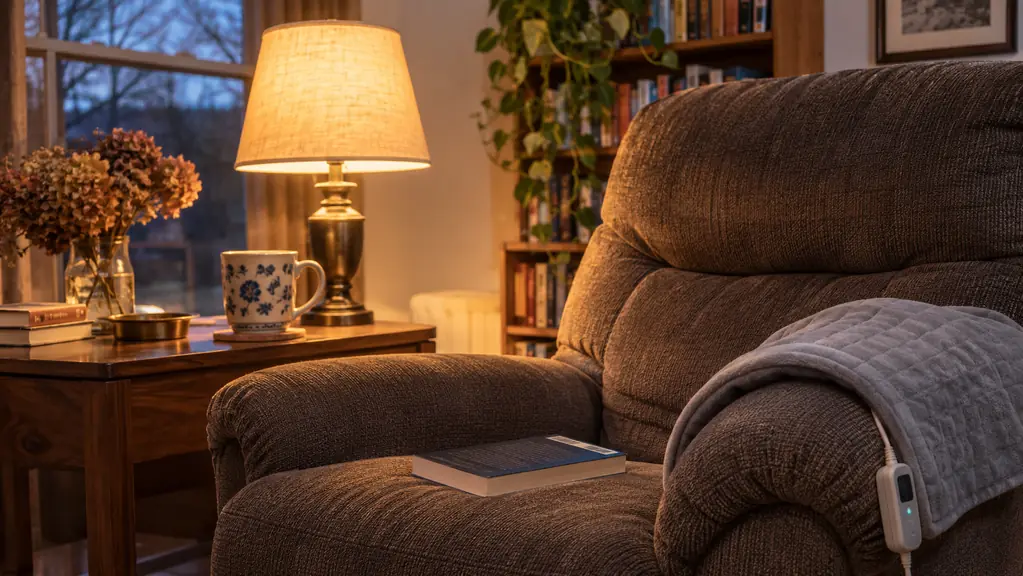
It came out of the box in early October and went onto the recliner in the living room, and that is where it has stayed. My routine is not complicated. Around eight in the evening, after the dishes, I sit down, plug it in, press the button on the controller until the second light comes on, and let it warm for a few minutes before I lean back against it. Twenty-five to thirty minutes with a book is my usual. On the nights when the cold gets into the house, the ones where the wind comes down off the hill and the windows rattle, I use the third setting instead.
It went to church with me twice. Wednesday choir rehearsals run long in December, and standing on a riser for ninety minutes is harder on my back than anything I do at home. I would arrive early, sit in the fellowship hall, and use the pad on the second setting for twenty minutes before I drove home. I also packed it for the drive to Boise to see the grandchildren. It runs off a wall outlet, so it stayed folded in the back seat and waited for the hotel room rather than riding on my lap.
Six hours on I-90 is a long time in one seat, and the grandkids are three, five, seven and nine, which means the visit itself is not restful. The pad was the thing I looked forward to at the end of those days. I would get to the hotel, plug it in, and lie on my side with it against the right side of my low back. I do not sleep on it. The two-hour shutoff means it turns itself off whether I am awake or not, and that is the only reason I am willing to close my eyes with it going. That detail matters more to me at sixty-three than it would have at forty.
The Four Heat Settings, and the Two I Actually Use
Four settings sounds like a small thing until you have spent a winter with a pad that only has two. The lowest setting is barely warm, more of a suggestion than heat, and I use it in November when the house sits at sixty-eight and my back is only complaining a little. The second setting is where I live. It is warm enough that I can feel something happening, and not so warm that I start checking my skin every few minutes.
The third setting is for the wind-down-the-hill nights and for the day after I have been on my feet in the kitchen making soup for the freezer. The fourth is more heat than I want against bare skin for very long. I have used it twice, both times on my shoulders after hauling groceries in, and both times I moved back down to three inside of ten minutes. The controller is push-button and there is a light for each setting, so I can see where I am in a dark living room without turning on a lamp and waking Gary. The listing mentions two heating elements, and I believe it. The warmth comes up evenly across the width of the pad instead of in one hot spot in the middle, which is what my old pad did in my thirties.
Why the Twelve by Twenty-Four Inch Size Matters More Than the Heat
The Sunbeam measures twelve inches by twenty-four inches. That reads like a number off a spec sheet, but it is the reason everything else went into the closet. My low back, from the top of my hips to the bottom of my ribs, is about eleven inches. A twelve-inch-wide pad covers it end to end, which means I am not adjusting it every four minutes to chase the sore spot. The twenty-four inches is long enough to wrap a little around each side, so I get heat on the right side where the trouble lives without lying on my stomach, which I cannot do for long anyway.
The listing also names neck and shoulders, and here I will be honest with you. On my frame, twelve by twenty-four covers my low back beautifully and my shoulders decently if I drape it over the back of the recliner. It does not do neck and low back at the same time. Nothing this size would. My physical therapist told me to heat one area at a time anyway, so that has not been a hardship, but if you are picturing a pad that blankets your whole spine while you read, this is not that pad and I would not want you to buy it expecting otherwise.
Twelve inches wide is exactly my low back, top of the hips to bottom of the ribs. That single measurement is why the other pads went into the closet.
The Controller, the Lights, and the Two-Hour Shutoff
The controller sits at the end of the cord with push buttons and a row of small lights, one for each setting. It is simple in the way I appreciate at sixty-three and in the dark. There is no menu, nothing to program, and nothing that beeps at me. Press the button, the light moves, the pad gets warmer. That is the entire interaction, and after five months I can do it without looking.
The two-hour auto shutoff is the part I trust and the part that annoys me. I trust it because I am a person who has left a curling iron on and driven to church. Knowing the pad will turn itself off takes the worry out of the evening, and it is the reason I am comfortable reading with it against my back while my eyes get heavy. It annoys me because it always seems to land in the last chapter. When the light goes out, the heat goes with it, and if I want more I have to press the button again and sit through the warm-up. That is a small thing. It is also the single most reliable reason I get up out of the recliner at nine-thirty, so perhaps it has done me a favor.
Where It Fell Short
The outlet. The one thing I would change about the Sunbeam is that it lives where the plug is, and in my house that means the recliner. I would not carry it to the kitchen table to use while I paint, and I would not count on it during a January power outage, which in Spokane is not a hypothetical. If you want something you can walk around the house with, this is not that product and no amount of good heat changes it.
The surface is microplush, which feels good through a cotton shirt and a little warm against bare skin in the shoulder months. In February that is a feature. In late March, when the house finally warms up and my back is behaving, I found myself reaching for it less, and not only because I did not need it as often.
One more honest note on the top setting. It gets hot enough that I would not want it pressed against bare skin for a long stretch. I have not been burned, and I do not use it that way, but I would not hand this to someone who cannot feel heat or shift away from it without a conversation first. That is not a knock on the pad. It is the nature of anything that plugs into a wall and makes warmth.
What I Liked
- Twelve by twenty-four inches covers an adult low back end to end
- Four settings that are genuinely different from each other
- Two-hour auto shutoff I trust enough to relax with
- Controller lights are readable in a dark room
- Microplush surface is soft through a shirt
- Five-year limited warranty
Where It Falls Short
- Runs off a wall outlet, so it stays in one room
- The two-hour cutoff always seems to land when you wanted ten more minutes
- Too small to cover neck and low back at the same time
- The top setting is more heat than I want on bare skin
What I Compared It To Before Settling In
I did not buy this in a vacuum. I spent two winters with a microwave heat wrap, the kind with the flaxseed inside, and I want to be fair to it. It is portable, it costs almost nothing, and it works for about eleven minutes before it starts going cool in the middle. What ended the relationship was the reheating. Twenty-five minutes of heat meant two trips to the microwave and one trip to the kitchen at the exact moment I had finally gotten comfortable. The pad does not go cold. That is the whole difference, and it is worth more than I expected.
I also had a small rectangular pad from years ago, roughly half this size, and the comparison is not close for a low back. The small one was fine for a shoulder or a wrist. On my back it heated one square in the middle and left the sore edges cold, so I was forever sliding it two inches left, then two inches right. The size of the Sunbeam is the upgrade, more than the settings, more than the controller. If you already own a small pad and you are wondering whether the jump is worth it, stand in front of a mirror with a tape measure first. Eleven inches across is what most adult low backs measure, and most small pads do not get there.
Who This Is For
This is for the person with a sore, stiff low back and a chair they sit in every evening, who wants heat across the whole area rather than a hot spot they have to chase. It is for anyone who has been through the rice sock phase and the microwave wrap phase and is tired of reheating things. It is also for the person whose doctor or physical therapist has already said heat is fine for their situation and who wants a pad that turns itself off. That last part matters. I sing alto in a choir with women in their seventies, and every one of them will tell you the automatic shutoff is the reason they replaced the pad they had in the nineties.
Who Should Skip It
Skip it if you need heat while you move around the house, because it is tied to an outlet. Skip it if you want neck, shoulders and low back covered at once, because twelve by twenty-four does one area well and the others by turns. Skip it if you want to fall asleep with heat on and leave it running all night, because the shutoff ends at two hours whether the night is over or not. And skip it entirely if your pain is new, sharp, or worse than it was a month ago. That is a call for your doctor, not a product a retired art teacher bought at her kitchen table.
The one thing that got me through a Spokane winter
Twelve by twenty-four inches, four heat settings, a two-hour auto shutoff, and a five-year limited warranty. It lives on my recliner from October to March and earns its spot.
Amazon Check Today's Price on Amazon →I am not going to tell you a heating pad fixed my back. It did not, and anyone who says so is selling something. What it did was make the hours between eight and ten in the evening comfortable enough that I stopped dreading them. For a woman who paints watercolors at the kitchen table, sings on Sundays, and drives six hours to see four grandchildren, that is worth a good deal. If your situation sounds like mine, this is a sensible pad and the size is the reason. If it does not sound like mine, I hope the above saves you a return.