

I did not want to like the MUELLER Sports Medicine Lumbar Back Brace. That is the honest place to start. Over the past five years I have bought four different back supports, and three of them are folded in the bottom drawer of my bedroom dresser, still faintly smelling of the plastic they shipped in.
My back went out at 58. A disc flare-up, worse on the right side, the kind of thing where you plan your entire day around how many times you will have to stand up. I am 63 now, retired after thirty-one years teaching elementary art in Spokane, and I still sing alto in my church choir on Sundays and at Wednesday night rehearsal. Ninety minutes on my feet, twice a week, was the hardest part of my week. That is the exact problem I wanted this brace to solve. It solved part of it. Not all of it. This review is about which part.
The Quick Verdict
A firm, well-built brace that genuinely gets me through a long rehearsal on my feet. It does not breathe, it does not hide under clothing, and it is not a cure. I would buy it again knowing all three of those things.
Amazon Check Today's Price →The brace that is still on the hook by my door five months later
Four steel springs, a pad you can take out, and an adjustment that stays where you set it. Sizing runs on waist measurement, so check the chart before you order.
Amazon Check Today's Price on Amazon →The Honest Version, Up Front
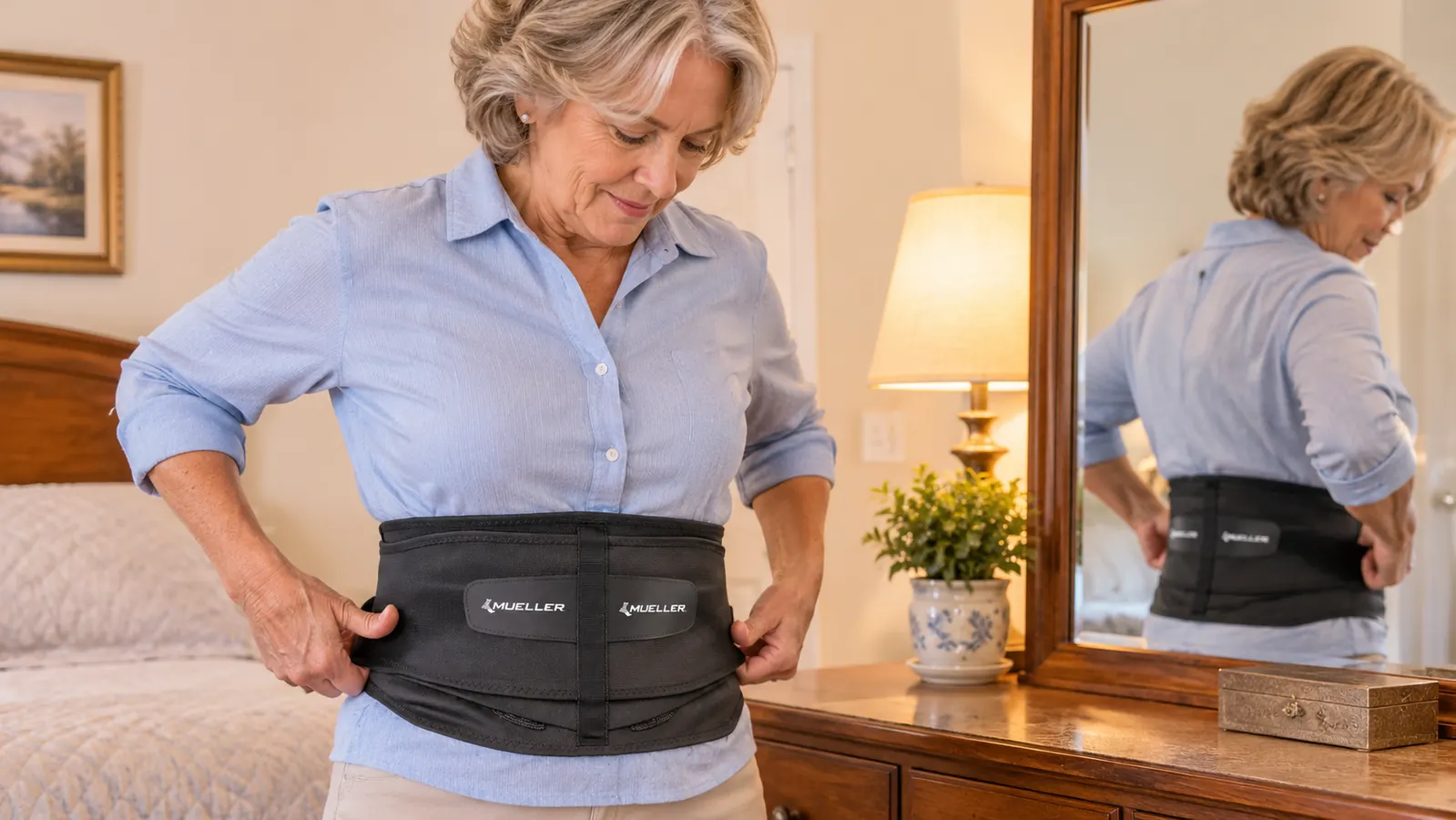
The short version is this. The MUELLER lumbar brace is a firm, structured belt with four steel springs sewn up the back and a pad you can remove. It is not a soft elastic band that stretches on like a tube top. You wrap it, you pull the adjustment until it is snug, and you feel it hold you in a slightly different posture than the one you were in ten seconds earlier.
What the product photos do not tell you is that it weighs 16 ounces. That does not sound like much until you have worn it for three hours straight. It is made from neoprene and polyester, and neoprene is a rubber, so it does not breathe. By the end of a Wednesday rehearsal in July, the small of my back is damp, and I take the brace off in the car before I drive home.
The second thing the photos do not tell you is that it helps you stand, and it does not fix your back. The disc on the right side is still a disc on the right side. What changed is that I can get through a full rehearsal without that deep ache that used to make me sit down on the front pew and pretend I was fine. That is not nothing. That is most of my life.
I say all of that up front because I think the brace is worth buying anyway, and I would rather you buy it knowing what it is than buy it expecting something else and leave a one-star review about it. It is a support. It supports. It is not a treatment, and it is not a substitute for the physical therapy that actually got me walking normally again a few years back. If you are looking for something that will make the problem disappear, this is not that, and no brace at this price is.
What it is, honestly, is a tool. A good one. The same way a good pair of work boots is a tool and not a foot cure. You put it on when the day is going to ask something of your back, and you take it off when the day is over.
How I Have Actually Used It
I bought mine in February and I have worn it, on average, three days a week since. Choir rehearsal on Wednesday. Sunday service. Long afternoons standing at the easel by the kitchen window, when I am working on a watercolor and forget to get up and move around for two hours at a stretch.
The first week I wore it too tight. That is the mistake I would warn anybody about. The adjustment is generous, and because the brace is stiff, it is easy to crank it down until you feel like a suitcase with a strap around it. That is not the point. Snug, not tight. Once I made that adjustment, I stopped getting a red line across my hip bones after rehearsal.
The second thing I learned is that it works best when I put it on before I stand up, not after. If I wait until the ache starts, it takes twenty minutes or so before the brace feels like it is doing anything at all. If I put it on in the church parking lot before rehearsal, the ache never really arrives. That shift, from reacting to anticipating, is the single most useful change I made with this thing.
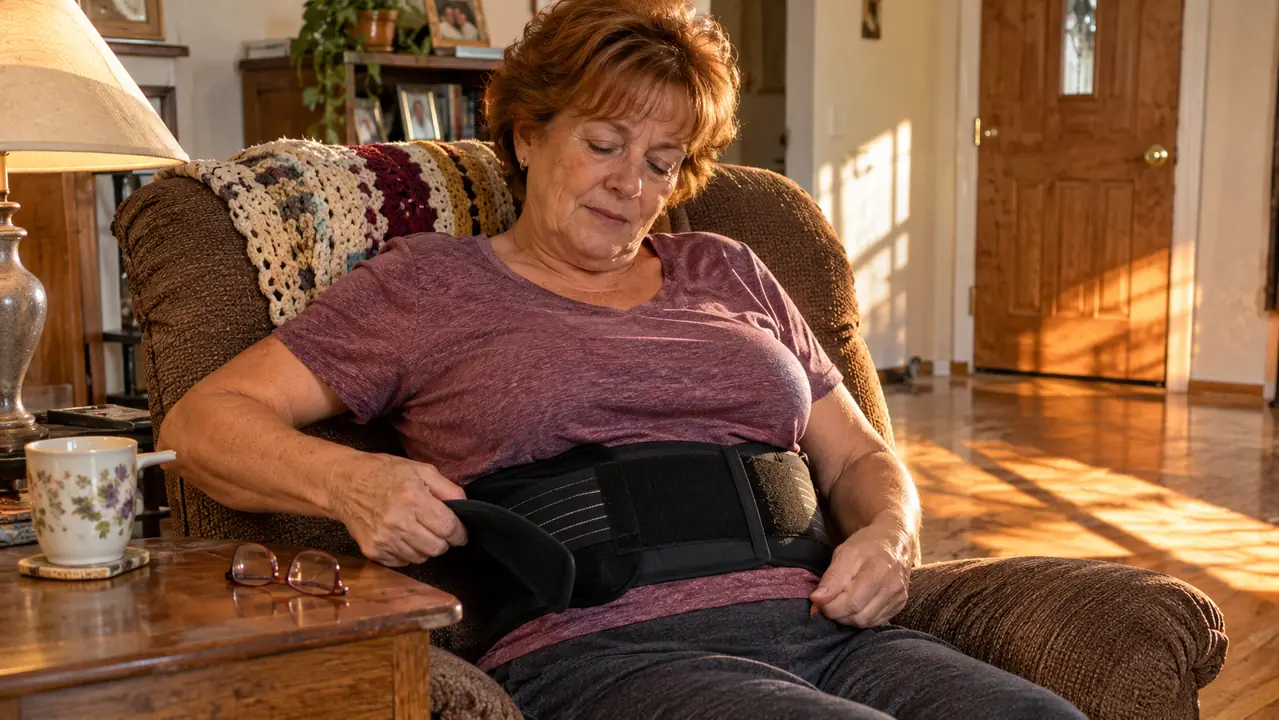
The third thing I learned is about the pad. It comes out, and it changes the brace. With the pad in, it sits firmer against the lower back and it is what I wear for rehearsal and for Sunday service. With the pad out, it is less bulky and easier to wear under a looser shirt for an errand or a drive. I take it out for the six-hour drive to Boise to see the grandkids, because sitting in a car seat is not the same job as standing on a hard floor.
I am not a doctor and I am not going to write like one. My physical therapist knows I wear this brace and she has no objection to it. If your back pain is new, or sharp, or getting worse instead of better, please see somebody before you spend money on anything you found on the internet. Mine is old, familiar, and managed. That is the only reason I feel comfortable writing about it at all.
Ninety minutes on my feet at Wednesday rehearsal, without the front-pew sit-down. That one change is why the brace is still hanging by my door five months later.
The Four Steel Springs Are the Whole Story
Four steel springs run up the back of the brace. That is the real difference between this and the soft supports I tried before it. A soft elastic belt hugs you. This one pushes back.
When I lean forward to reach for something, the springs resist the lean and I straighten up without thinking about it. That is what posture correction means in practice. It is not mysterious. It is mechanical. You have a piece of steel against your spine telling you that you are slouching, and after a week or two you stop slouching because you are tired of arguing with it.
The manufacturer describes the compression as firm, targeted, and supportive, and I would use the same three words. It is not a gentle reminder. It is a hand on your back saying stand up straight. If you have ever worn a soft belt and wondered whether it was doing anything, you will not wonder with this one. You will know within the first minute.
What the Removable Pad Actually Does
The pad is the part I did not expect to care about. In, the brace sits firmer and the pressure spreads a little wider across the lower back. That is the version I go to for a long rehearsal or a Sunday morning when I know I will be standing for the whole service and then standing again at the coffee hour afterward.
Out, the brace is thinner, and I can wear it under a cardigan without it looking like I am carrying a paperback behind me. I also take it out for any long sitting, meaning the drive to Boise and back, and the occasional afternoon in the recliner when my back is tired but I am not going anywhere.
That is a small thing. Small things are what determine whether a brace ends up in the bottom drawer or on the hook by the door, and after five months mine is still on the hook.
What Bugged Me
The heat. Neoprene does not breathe, and there is nothing to be done about it. The listing calls the brace odor resistant, and I think that is fair, but resistant is not immune. If you wear it six hours a day in August you are going to want to wash it, and washing means hand wash, cold water, air dry, and most of a day on a towel before it is ready again. Two of these would solve that. One will not.
It shows under clothing. This is not a discreet brace. The springs and the pad create a visible shape at the small of your back, and if you wear anything fitted, people can tell you are wearing a brace, because you are. I wear mine over a camisole and under a roomy cardigan, and I have stopped caring what it looks like at church. At my granddaughter's school concert in Boise last spring, I cared a little.
It is 16 ounces, and after about four hours I feel it. Not painfully. Just present, the way a heavy watch is present. The top edge starts to press under my ribs when I sit for a long stretch in a chair with a high back, so on long drives I loosen it or take it off entirely and put it back on when I get out of the car.
And the sizing is unforgiving. There is no stretch and no forgiveness in a brace with steel in it, so if you guess, you guess wrong. I will get to that in its own section below, because it deserves one.
None of these are deal breakers for me, obviously, since I am still wearing it. But if you are the kind of person who cannot stand being hot, or who cannot stand looking like you are wearing medical equipment, this is not your brace, and no amount of adjusting will change that. Better to know now.
What I Liked
- Four steel springs give real, firm support instead of a soft hug
- The removable pad lets you change how firm the brace feels depending on the day
- The adjustment holds where you set it, through a full rehearsal and a church service
- Five months of regular wear with no fraying, no bent springs, no loss of shape
- Lightweight enough at 16 ounces to wear under a cardigan for an afternoon
Where It Falls Short
- Neoprene does not breathe, and you will sweat under it in warm weather
- Visible under fitted clothing, so it is not a discreet option
- Hand wash only, and most of a day to air dry
- 16 ounces becomes noticeable after about four hours
- Sizing runs strictly on waist measurement and is unforgiving if you guess
Five Months Later: How It Has Held Up
I have worn this brace through five months, two road trips to Boise, one very hot July, and a full choir season. It has not frayed. The springs have not bent out of shape. The adjustment still holds where I set it. That sounds like a low bar until you have had a soft belt lose its stretch inside two months, which happened to me twice, and one of those started rolling at the top edge by week three.
The neoprene has softened a little, which I like. The stitching at the edges looks the way it did in February. If you are wondering whether this is a two-month disposable, it is not. It is built like something that expects to be worn.
One word on care, because I nearly ruined mine. Do not put it in the dryer. I had my hand on the door in March and a friend who has worn one of these for years told me that would be the end of it. Air dry, on a towel, overnight. That is the whole maintenance routine, and it is the only reason mine still looks like it does.
Where It Helps and Where It Does Not
It helps most with standing. Rehearsal, service, a long grocery shop, an afternoon at the easel, a couple of hours in the yard before the heat sets in. Those are the days when the brace earns its place, because those are the days when my back would otherwise start complaining around the forty minute mark and keep complaining until I sat down.
It helps somewhat with lifting, meaning the small lifting of daily life, a laundry basket, a bag of groceries, a case of water. It does not turn me into someone who should be moving furniture. I still ask Gary to carry the heavy things and I still use my legs, not my back, when I pick anything up off the floor.
It does not help much with sitting. This surprised me. I assumed a brace was a brace, and it would help however I was positioned. But the springs are there to hold you upright while you are upright, and when I sit for a long stretch in a chair with a high back, the top edge starts pressing under my ribs and I end up loosening it. Sitting is my recliner and my firm mattress problem, not my brace problem.
And it does nothing for the mornings. The first twenty minutes after I get out of bed are still stiff and slow, brace or no brace. That is what the stretching routine from physical therapy is for. The brace is for the hours after that.
Sizing Is Where People Get Burned
Measure around the widest part of your waist. Not your hips. Not your jeans size. Not the number you were in 2019. Your waist, with a soft tape, standing up, before you have eaten a big meal.
The Regular fits waists from 28 to 50 inches. The Small fits 22 to 30 inches. There is a Plus size above the Regular. I am a Regular, and I sit in the lower middle of that range, which is a comfortable place to be. If you land at the very top of a range, I would think hard about moving up, because you want adjustment left over. You do not want to be pulling the brace to its limit every single time you put it on.
The first one I ordered, I ordered without measuring. It went back. That was entirely my own fault and it cost me a week of standing at rehearsal without it. Measure, write the number down, and order from the number.
Who This Is For
If you have a familiar, managed lower back problem and the thing that sets it off is standing or lifting, this brace does what it says on the box. It is a good fit for a choir rehearsal, a long grocery shop, a shift on your feet, or an afternoon of yard work before the heat. It is also a good fit for anyone who tried a soft elastic belt and quietly wondered whether it was doing anything at all, because the four steel springs are the difference and you can feel it in the first minute. And it is a good fit for someone who wants one brace that will last a few seasons instead of three that will not.
Who Should Skip It
Skip it if you want something invisible. Skip it if you run hot, because you will be uncomfortable by hour two and miserable by hour four. Skip it if you have not talked to a doctor or a physical therapist about your back yet, because a brace can mask a problem that needs an actual diagnosis. And skip it if you are picturing something soft to sleep in, because this is firm, it has steel in it, and it was not built for a mattress.
Five months in, mine is still on the hook by the door
The MUELLER lumbar brace is not comfortable the way a soft belt is comfortable. It is comfortable the way a good pair of work boots is comfortable, which is to say it earns it. Measure your waist, order the right size, and wear it snug rather than tight.
Amazon Check Today's Price on Amazon →