

Every May I make the same mistake. I look at the four raised beds behind my house, decide they got away from me over the winter, and spend one Saturday doing what should have taken three. By Sunday night I am in the recliner with a heating pad and a dull ache on my right side that takes four days to leave. I am 63, I taught elementary art for thirty-one years, and my lower back has been negotiating with me since a disc flare-up at 58. Last spring I stopped treating a brace as something you reach for after the damage and started treating it as part of the job, the way I treat gloves. The one I have worn since is the MUELLER Sports Medicine Lumbar Back Brace with the removable pad, and this is how I actually wear it: yard work, errands, the long stand at the church choir fundraiser, all of it.
If you have bought a back brace, taken it home, strapped it on for an afternoon and decided it was either useless or unbearable, the problem is usually not the brace. It is fit, height and tension, three things nobody explains in the two lines printed on the box. Get those right and the thing earns its place on the hook by the back door. Get them wrong and you get a hot band of fabric around your middle and an opinion you did not need to form. What follows is the order I do it in. None of it is medical advice. I am a retired teacher with a cranky disc, not a clinician, and if your pain is new, sharp or getting worse, call your doctor or your physical therapist before you spend anything on a brace.
The brace that made it through a full spring of yard work
Four steel springs, a removable pad, and a closure that adjusts with two hands. I have worn this one through beds, groceries and choir fundraisers. Current pricing and the size chart are on the listing.
Amazon Check Today's Price on Amazon →Step 1: Measure around the widest part of your waist, not your pants size
The first brace I ordered was a waste of an afternoon because I guessed. I used my jeans size, which is a 10, and the thing arrived cut for a much smaller middle. Measure around the widest part of your waist, over a shirt, standing up, with a soft tape and no sucking in. Whatever number that gives you is the number you use. The listing's chart starts at Small for 22 to 30 inches and Regular for 28 to 50 inches, and there is a Plus as well, so a woman my size lands squarely in Regular with room on either side. If you land near a boundary, do not split the difference in your head. Ask the seller.
Two things about the MUELLER brace make the sizing forgiving. The closure is adjustable, so you are not locked into one circumference, and the material is stretchable, which means it moves with you instead of fighting you when you bend. The whole thing weighs 16 ounces. That matters more than it sounds. A brace heavy enough to sag is a brace you will be hitching up every ten minutes in the garden, and a brace you are constantly hitching up is one you will quietly stop wearing by June. It is also odor resistant, which is a polite way of saying you can sweat in it and not dread the next time you reach for it.
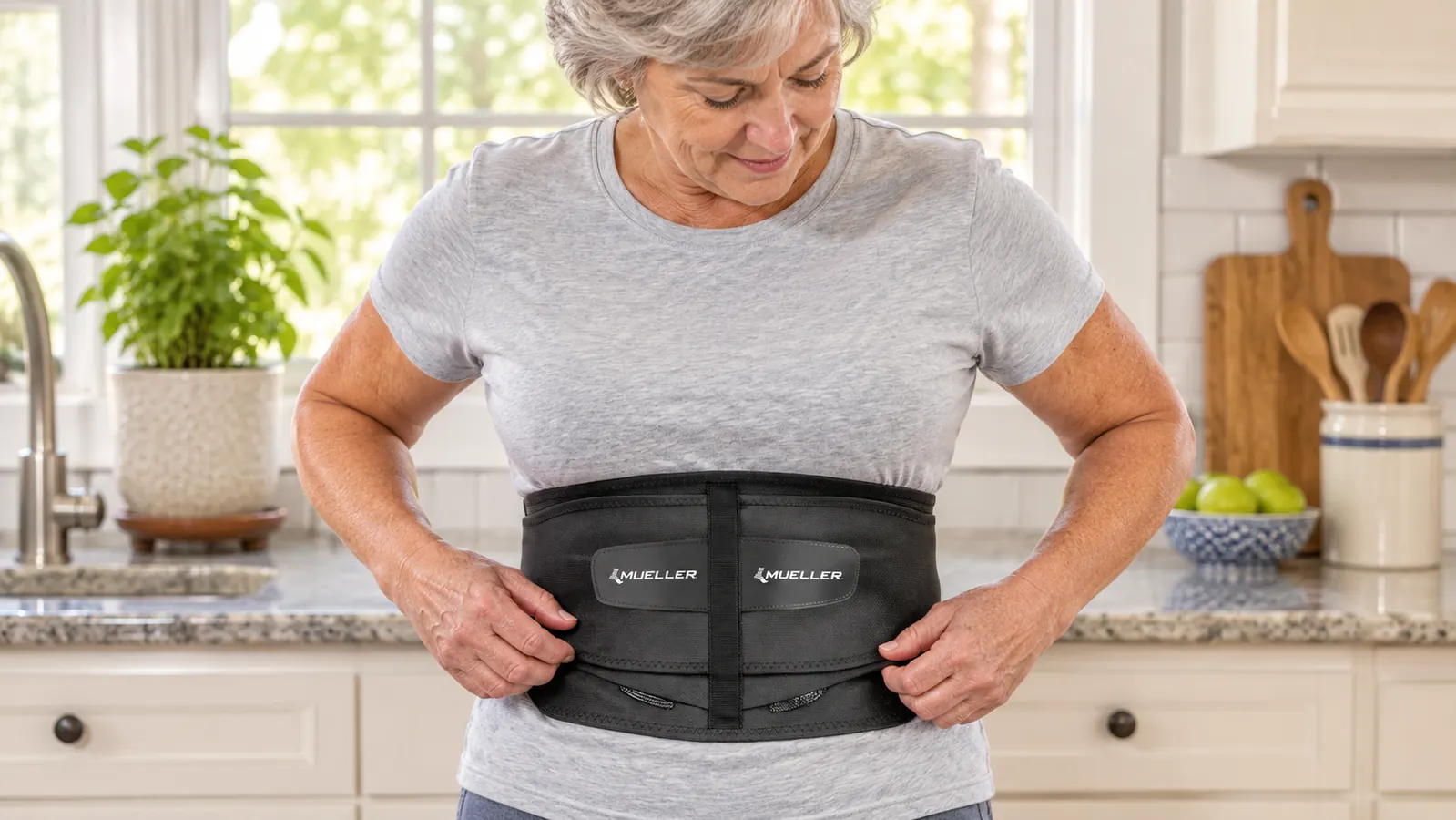
Step 2: Put it on over a smooth layer, then find the right height
Height is where most people go wrong, and it is the reason a brace can feel like it is doing nothing. The business part of this one is four steel springs that run up the back. Those springs need to sit across your lower back, roughly from the top of your pelvis to the small of your back, not up between your shoulder blades and not so low that it is riding on your tailbone. Put it on, stand up, and use a doorway mirror or ask somebody to look. Slide it up or down before you tighten anything, because once it is snug it stays where you put it.
Wear it over a smooth layer. A cotton t-shirt works. A thick sweatshirt with a bunched hem does not, and neither does bare skin for a full afternoon, because anything will rub once you start sweating. The removable pad goes against your back. I use it. Gary tried my brace once and pulled the pad out because the pressure felt like too much, and that is fine, it comes out with one hand. Here is the part where I remind you that I am not a doctor. If a pad pressing on your spine makes you wince rather than feel supported, take it out and mention it at your next physical therapy appointment.
Step 3: Set the tension for the task, not for the whole day
There are two tensions and they are not the same. The first is what I call puttering tension. It is snug enough that you feel the support when you stand, and loose enough that you can take a full breath and put your hands on your hips without the thing biting. That is the setting for standing at the counter, sorting mail, waiting in a line. The second is lifting tension. Before I move a bag of compost or haul a bucket, I pull the ends a couple of inches firmer, do the lift, and then ease it back to puttering. Two hands, three seconds, no drama.
What I do not do is wear it at lifting tension all day. That was my mistake the first week, and by four in the afternoon my ribs ached and I was short with Gary over nothing at all. The other rule I keep is that I loosen it before I sit down, whether that is the car seat or the recliner. Sitting in a tightened brace is genuinely unpleasant, and unpleasant is how good habits die.
A brace cranked down for eight hours is not more support. It is just pressure, and pressure is what makes you quit wearing it by June.

Step 4: Wear it through the yard work, then take it off at the door
The yard is where this earns its keep, but only if you put it on before you go out, not after the first twinge. Mine goes on in the kitchen, over my shirt, while the coffee is still hot. Then I work in blocks. Forty-five minutes of weeding or planting, then I stand up, walk to the end of the driveway and back, and drink some water. The brace does not make me bionic. It reminds me that I have a back, which is exactly the reminder I need at minute fifty of pulling bindweed out of the strawberries.
For the lifting parts, I set the firmer tension first, then lift with my knees and my hips rather than my spine. A brace is not a forklift. It cannot save you from a bad lift, it can only keep you from forgetting your posture halfway through a good one. When I move the bags of soil from the truck to the beds, the brace goes on before the first bag comes off the tailgate. When I kneel to plant, I use a kneeling pad and I keep the tension at puttering level, because kneeling in a tightened brace is miserable and I will not do it twice.
Then I take it off at the door. That is the whole ritual. Boots off, brace off, hanging on the hook. If I leave it on and sit in the recliner in it, I will have a red mark across my middle and a stiff afternoon. Taking it off is not a failure of the plan. It is the plan.
Step 5: Run errands and long standing by the same rules
Errands are the sneaky part, because nobody thinks of grocery shopping as back work. It is. It is standing in a checkout line on a hard floor, then reaching into a cart, then lifting bags out of the trunk. I wear the brace at puttering tension for the store and I do not wear it in the car on the way there. The drive to Boise to see the grandkids is six hours. Six hours in a lumbar brace would be a punishment, so it rides in the back seat and goes on when I get out to stretch.
Long standing is where I notice it most, honestly. Our church does a fundraiser dinner twice a year and I am on my feet behind a serving table for three hours. Two years ago I went home early and felt rotten about it. Last fall I wore the brace at puttering tension, kept one foot up on a low step stool when I could, and stayed to the end. It is not a dramatic story. It is just the difference between being able to help and sitting in the car waiting for Gary to finish.
One more thing about errands: I do not wear it for the whole day just because I am out and about. On, off, on, off. It goes on for the task and comes off for the sitting. The way it was explained to me, a brace is a tool for specific jobs, not a replacement for the muscles that are supposed to be doing the work. Wearing it from breakfast to bedtime turns a helpful thing into a crutch, and I have enough of those in the garage.
What Else Helps
Everything above is about the brace. None of it is the whole story. What has helped my back most over the last five years is a short set of hip hinge drills and gentle core work that my physical therapist gave me on a single photocopied page, done three mornings a week on the living room rug. The brace makes a Saturday in the beds possible. The exercises are what make the following Tuesday normal. I also walk. Not fast, not far, twenty minutes around the neighborhood after dinner, and I notice a difference in about a week when I skip it.
Around the house, the small stuff adds up. Our mattress is firm and that was a deliberate purchase after a bad month. The recliner has a rolled towel behind my lower back, not because the chair is bad but because I sit in it too long. I keep a step stool in the kitchen so I am not standing flat-footed at the counter for an hour, and I moved the heavy watering can to a shelf at hip height so I am not lifting it off the floor. None of this is interesting. All of it is why the brace worked when I finally bought the MUELLER one instead of using it as the only thing I did.
And the honest limits. A brace will not fix a disc, it will not replace a diagnosis, and it will not tell you when to stop. If you put it on and mow the whole lawn in one go because you feel fine, you have not solved the problem, you have just postponed the bill. If your pain runs down your leg, if you get numbness or tingling, if it wakes you at night, or if it is worse than it was a month ago, put the brace down and make an appointment. That is the advice I would give any friend at church, and I would say it before I said a word about which brace to buy.
Before the next Saturday gets away from you
Measure around the widest part of your waist, order the size the chart calls for, and set the tension for the job instead of the day. Four steel springs, a removable pad, and a closure you can adjust with two hands.
Amazon Check Today's Price on Amazon →