

I bought the Homedics Shiatsu Back Massager with Heat because my recliner had turned into a place where I sat carefully instead of a place where I relaxed. My lower back, the right side mostly, has been cranky since a disc flare-up at 58. I am 63 now, retired from teaching elementary art in Spokane, and my physical therapist has seen me through the worst of it. She is the one who told me heat and gentle motion can have a place at home, as long as I pay attention to what my back is telling me.
This is not a medical guide. I am not a doctor, and a massage pillow is not a treatment plan. If your pain is new, severe, or getting worse, call your doctor or physical therapist. What this is, is the routine I worked out over several weeks with the Homedics pillow in my living room recliner. It took me a while to stop treating it like a chair attachment and start using it like a tool. The difference came down to setup, speed, and knowing when to stop.
The Recliner Setup That Finally Made My Afternoons Easier
The Homedics Shiatsu Back Massager with Heat is the piece I reach for when my lower back is tight but not angry. It has circular kneading, vibration, heat, speed control, and a bi-direction control, with the controls built into the cushion.
Amazon Check Today's Price on Amazon →What the Homedics Massager Actually Does
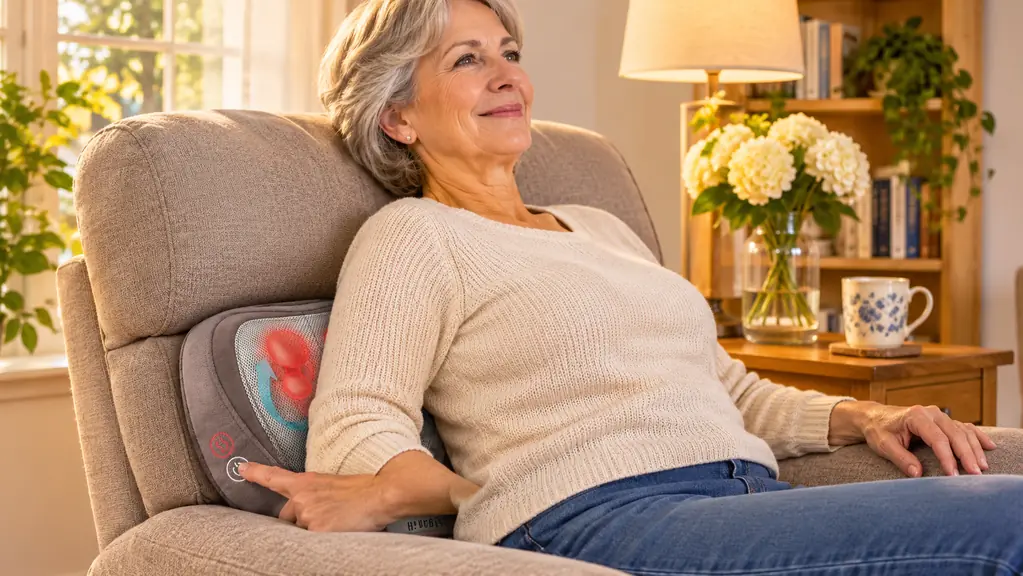
The Homedics Shiatsu Back Massager with Heat is a massage pillow, not a recliner insert and not a chair. It is corded electric, 13.78 by 5.12 by 10.43 inches, and 4.18 pounds. It has circular kneading, vibration, heat, a speed control, and a bi-direction control, and the controls are built into the cushion. That last part matters more than I expected. I do not have to stand up to change a setting while I am leaning back.
It works on the muscles beside the spine, the ones that get tight after too long at my kitchen-table easel or after the six-hour drive to Boise to see the grandkids. It kneads in a circle, and you can reverse the direction. The heat is gentle, not a hot pack. The vibration is there if you want it. I usually do not. It will not diagnose you or fix a disc. If you want a way to loosen a tight lower back at home while you sit in your own recliner, it is useful.
The Five Steps That Made It Useful
I did not get much from the massager the first week. I put it behind me, turned it on, and expected it to do the work. That is not how it went. These five steps are what changed it from a buzzing pillow into something I use most afternoons. None of them are complicated. They are the things I wish someone had told me before I spent a week making my back sore.
Step 1: Put the Pillow Against Your Lower Back, Not on the Bony Part
The Homedics pillow is wide enough to cover the lower back, but it does not know where your pain is. I set it in the recliner first, then sat down. When I tried to wedge it behind me after I was already seated, it always ended up too high, right on the bony part of my spine. That felt like a poke, not a massage. What worked was placing the pillow against the lower back where the pain actually lives, a little to the right for me, and letting the recliner hold it there.
The circular kneading needs some muscle under it. If it is grinding on bone, you will tense up, and a tense back defeats the point. I also keep a thin folded throw blanket over the pillow when I want the pressure softer. The blanket does not change the machine. It changes how much of the kneading reaches me. On a tighter day I use one layer. On a day when my back is already irritated, I use two and let the heat do more of the work.
Step 2: Start With Heat and the Lowest Speed
The controls are built into the cushion, so I am not patting the floor for something I set down and cannot find. I turn on the heat first and let it warm for a minute or two before I lean back. Then I start on the lowest speed. The heat is not a hot pack. It is a gentle warmth that takes the edge off. The vibration is the part I use least. I usually leave it off at first, because vibration on a sore back can feel like noise.
The speed control is what lets me stay there. On high from the start, I last about two minutes. On low, I can settle in and let the kneading do its work. If your back is flaring, low is not a compromise. It is the whole point. I also do not turn the heat on and forget it. If the cushion starts to feel too warm against my back, I turn the heat off and keep the kneading going.
Step 3: Lean Back Only as Far as the Kneading Stays Comfortable
The recliner is doing half the work here. If I lean all the way back, the pillow presses harder into my back. That can be good on a tight muscle and too much on an irritated one. I start with the chair mostly upright and lean back a few inches at a time. When the pressure turns sharp, I stop and stay there. The right spot for me is about halfway back, with my feet flat on the floor and a small pillow under my knees.
This is where the 3D shiatsu action matters. It is not a flat vibration. It kneads in a circle, and you feel the circle move. If I am leaned too far back, the circle feels like it is pushing me out of the chair. If I am too upright, I barely feel it. I adjust the chair before I adjust the speed. The chair changes the pressure. The speed changes the pace. Both matter, but the chair comes first.
Step 4: Use the Bi-Direction Control When One Spot Gets Tired
The bi-direction control reverses the kneading direction. I did not think I would care about that. I care now. When the pillow has been circling one way for a few minutes, the muscle seems to get used to it. Reversing the direction feels like a fresh set of hands, and it keeps me from chasing one knot until I am sore. I use one direction for the first few minutes, then switch. If my right side is the tight one, I shift my hips an inch or two so the kneading lands more on that side.
The pillow is wide enough to cover the whole lower back, but it does not know where your pain is. You have to place yourself. The integrated controls make that easy because I am not reaching behind me or standing up to change a setting. I can shift, reverse, and settle again without losing the position I just found. That sounds minor. It is not. The less I have to move around, the more likely I am to stay with a useful ten minutes instead of giving up.
Step 5: Stop at Ten or Fifteen Minutes and Move
This is the step I got wrong. The first week, I stayed in the recliner for half an hour because it felt good. I was sore the next day, the kind of sore that makes you think the thing you bought is a mistake. My physical therapist was not surprised. Heat and kneading can calm a muscle, but staying still in one position for a long time is its own problem. Now I set a kitchen timer for twelve minutes.
When it goes off, I turn the Homedics pillow off, stand up, and walk to the kitchen for water. I do a few slow standing bends, not stretches that hurt, just movement. Then I sit back down in the recliner without the massager and read for a while. The massage is the start of feeling better, not the whole treatment. If I am having a bad day, I do not push the time longer. I use less heat, lower speed, and shorter sessions.
Twelve minutes with the pillow against the right spot, then standing up and walking to the kitchen, did more for my afternoons than thirty minutes of staying put.

What I Got Wrong at First
I treated the massager like a chair I could turn on and forget. I also used it on a day when my back was hot and inflamed, which was a mistake. The heat felt good in the moment, and I stayed too long. The next morning I was stiffer than before. Now I use it on the tight, achy afternoons, the ones that follow too long at the easel or a long drive. If my back feels inflamed, I skip it and use an ice pack instead. That advice came from my physical therapist, not from me.
The other thing I got wrong was expecting the pillow to reach the spot without help. It is 4.18 pounds and it stays where you put it, but it does not crawl around to find the knot. I had to learn to place it, lean into it, and shift my hips. I also had to learn that softer is not always weaker. A folded blanket between me and the cushion often lets me stay longer and get more relief than pressing in hard for two minutes and giving up.
What Else Helps
The massager is not the only thing in my routine, and I would not pretend it is. The biggest help has been the boring stuff my physical therapist gave me: a short set of gentle core and hip exercises, a walk around the block when the weather allows, and not sitting in the same chair all morning. The Homedics pillow fits into that routine because it is easy to use and easy to stop. I can use it for twelve minutes before choir practice and still have time to find my music folder.
I also pay attention to when I use it. I do not use it right after I have been lifting something heavy. I do not use it on a day when my back feels hot and swollen. I use it on the tight, achy afternoons. If I am unsure, I call my physical therapist. That is not a disclaimer I am adding for show. It is what I actually do. Gary has learned to hand me the kitchen timer without being asked, which tells you how often this little routine happens in our house.
I keep the pillow beside the recliner, not folded into a closet, because the whole routine works only if it is easier to use than to skip. The cord is part of the deal, so I plug it in before I sit down. If I wait until I am already settled, I will talk myself out of it. The same is true of the timer. I set it before I turn the massager on. Small pieces of friction matter when your back is the reason you are sitting down in the first place.
A Twelve-Minute Reset for the Afternoons Your Back Says No
The Homedics Shiatsu Back Massager with Heat is not a cure and it is not a chair. It is a corded massage pillow with circular kneading, heat, vibration, speed control, and a bi-direction control built into the cushion. For me, the useful part is the routine: place it low, start slow, lean back until the pressure is right, reverse when one spot gets tired, and stop before you overdo it.
Amazon Check Today's Price on Amazon →