
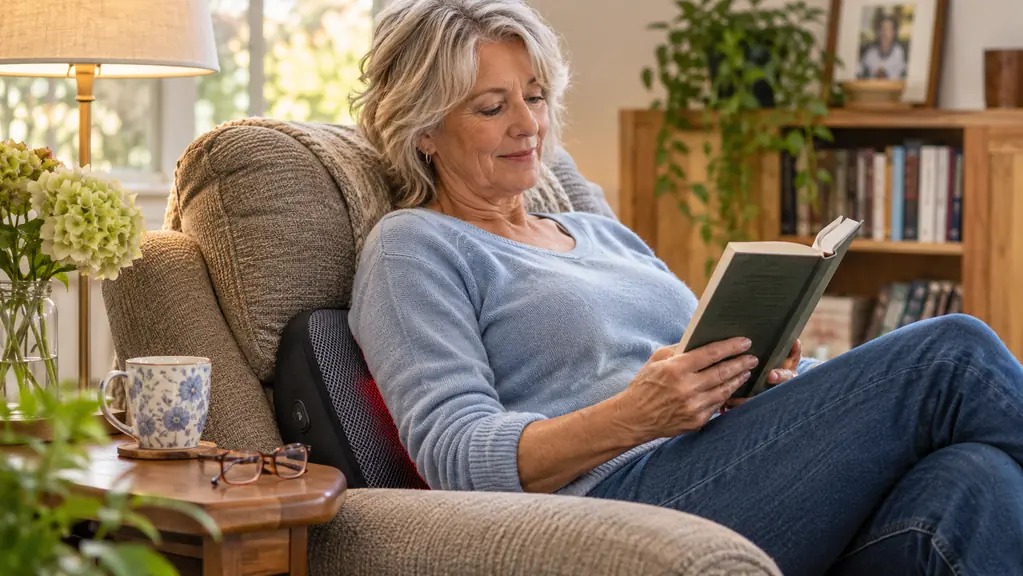
I bought the Homedics Shiatsu Back Massager with Heat on a Tuesday in February, mostly because I was tired of asking Gary to dig his thumbs into my lower back while the evening news played. I am 63, a retired elementary school art teacher in Spokane, and my lower back has been unreliable since a disc flare-up when I was 58. The right side is the cranky one. My physical therapist gave me a set of stretches I actually do, and they help. But some evenings the muscle on that side tightens into something like a fist, and stretching alone does not touch it. That is the honest reason a massage pillow ended up in my recliner.
It has been several months now. I have used it three or four nights a week, through choir season at church, through a stretch of watercolor painting before the spring auction, and through one six-hour drive to Boise to see the grandchildren. I am not a doctor and I will not pretend to be one. What I can tell you is what changed at home, what did not, and what I would want to know before spending my own money. If your back pain is new, severe, or getting worse, put this down and call your doctor or your physical therapist first. That part is not negotiable.
The Quick Verdict
A firm, corded kneading pillow that earns its spot beside the recliner on a bad lower-back evening. The heat makes the kneading easier to sit through. It is not a cure and it does not replace physical therapy.
Amazon Check Today's Price →The one thing in my living room that works on my back while I sit still
It kneads, it warms, and the controls are built into the cushion so nothing gets lost in the chair. Check today's price and the current listing details on Amazon.
Amazon Check Today's Price on Amazon →How I've Used It
The pillow lives in the living room recliner. I put it behind my lower back, lean into it, and let the rotating massage nodes work along either side of my spine. The first week I used it for maybe eight minutes at a time, because that was all my back wanted. These days it is fifteen or twenty minutes on a bad evening, less on a good one. The controls are built into the cushion itself, so I am not hunting for a remote that has slid between the chair cushions. I reach down, find the button by feel, and that is the whole ritual.
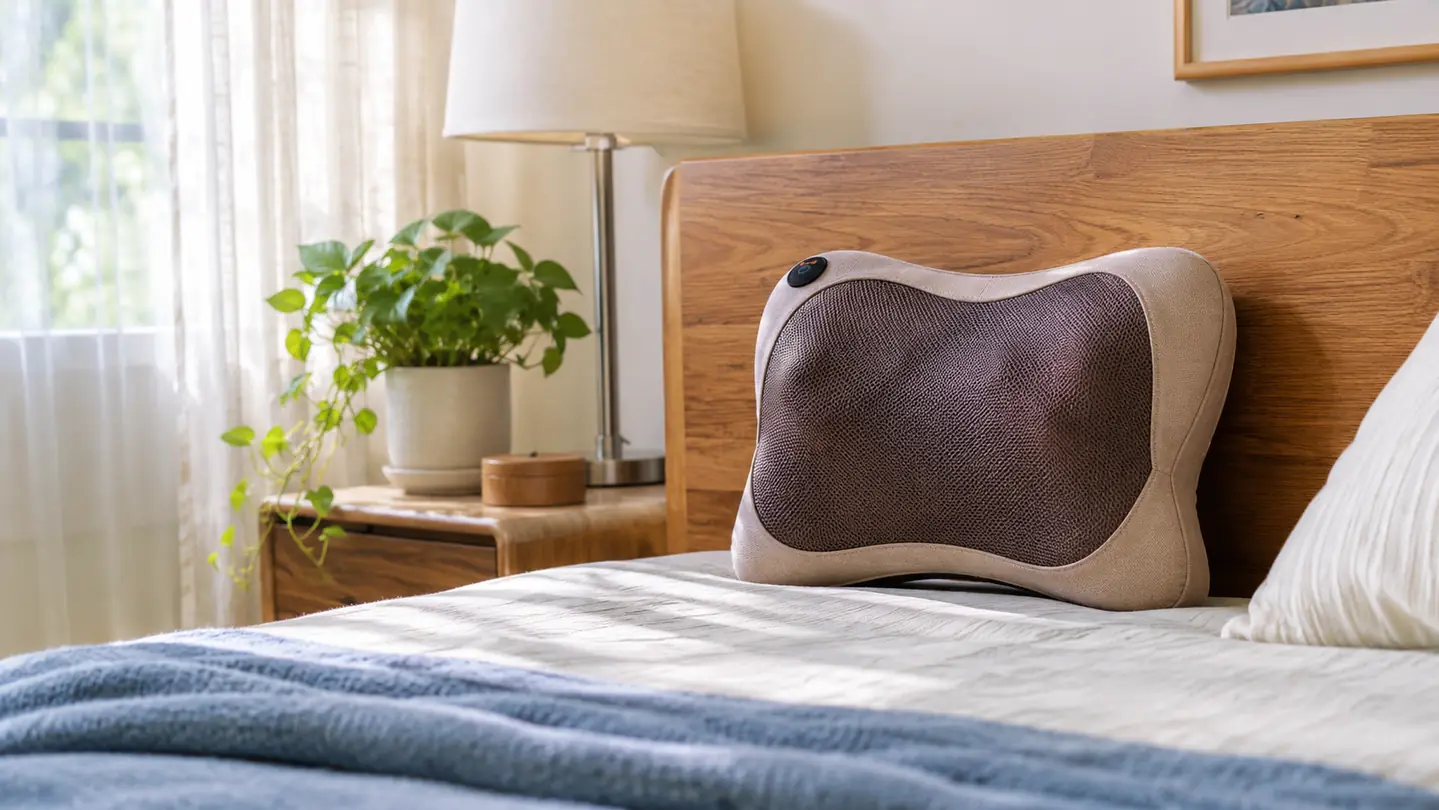
It is corded, which is the tradeoff. My recliner sits close enough to an outlet that it does not matter. If your favorite chair is in the middle of a room with no outlet nearby, it will matter a great deal, and no amount of good kneading makes up for a cord stretched across a walking path. Where I have landed: recliner for the lower back, and the firm queen mattress for the spot between my shoulder blades after a long afternoon of painting. On the mattress I lie on my back with the pillow under my upper spine and let the heat do its slow work.
One more place it has earned a job. The kitchen chair after choir rehearsal on Wednesday nights. I sing alto, rehearsal runs long, and I come home with my shoulders up around my ears. Ten minutes leaning back against a hard chair with the heat on, and I can sit through dinner without shifting around like a woman on a bus.
Before I bought anything, I tried the cheap versions first. I rolled a bath towel into a cylinder, taped it so it would hold, and wedged it into the small of my back in the recliner. Right idea, no engine in it. Pressure without movement just made the muscle feel pressed on, like a thumb that never moves. Then I tried a tennis ball in a knotted sock and worked it against the wall, which was closer to the real thing, except it required me to stand, and standing for ten minutes is not what my back wants at the end of a day. Both of those cost nothing and both of them ended up on the shelf in the garage. What I actually wanted was something that moved on its own while I stayed seated, and that is the specific gap this pillow fills.
What the Controls Actually Do
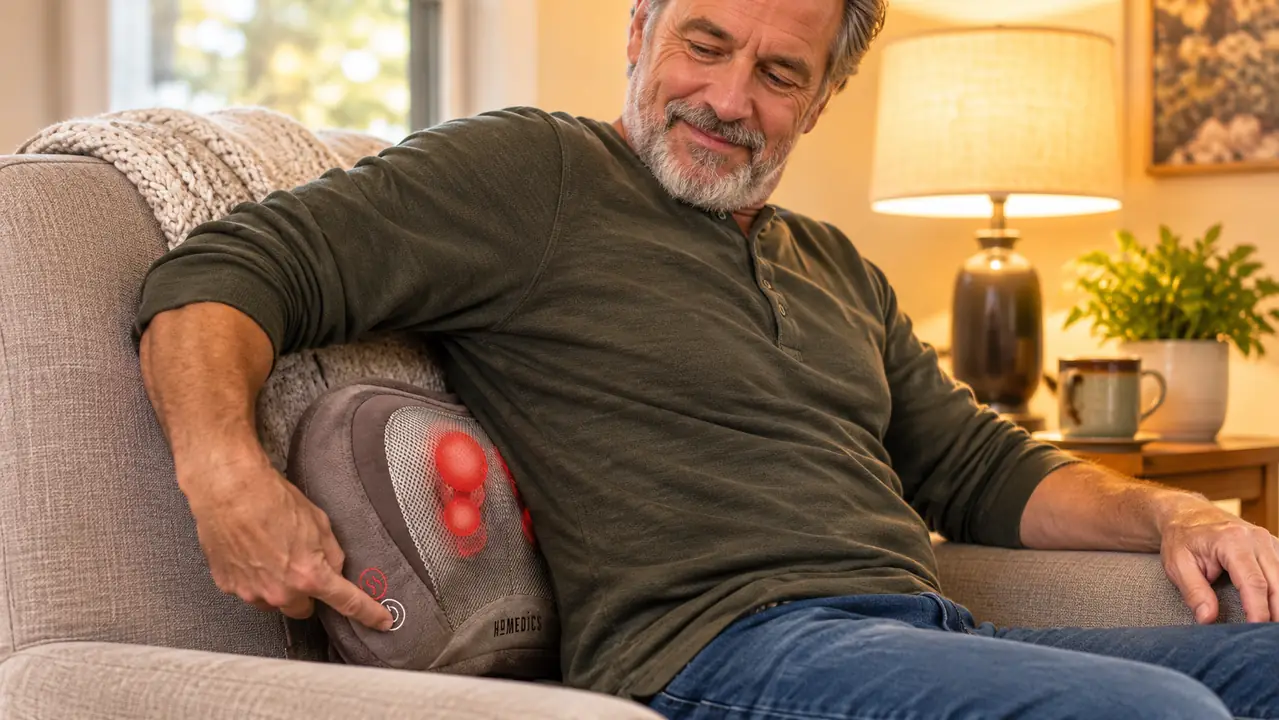
There is not much to learn here, which I count as a good thing at my age. One button starts the kneading. Another reverses the direction of the rotation, and that matters more than I expected, because after a few minutes in one direction the muscle seems to stop noticing and I need the change. There is a speed control that takes it from a slow, almost lazy knead to something considerably more assertive. And there is the heat.
The heat is what surprised me. On a cold Spokane morning, a warm pillow against a tight lower back loosens the whole area faster than the kneading alone. I use heat most of the time now. Not always. When the muscle is already angry, warmth sometimes makes it feel worse, and on those nights I turn the heat off and let the rotation work by itself. That is a judgment call I make, not something the pillow decides for me.
The unit is plastic and cushioned, and it weighs a bit over four pounds, so I can carry it from the recliner to the bedroom with one hand. It measures about 13.8 inches across and 10.4 inches tall, which fits the small of my back and also fits between my shoulder blades without me folding myself around it. This is not a travel gadget. It is closer to a piece of furniture, and it stays where you put it.
Nothing on the cushion counts minutes for me, so I set the kitchen timer. I learned that the hard way. The first week I left it running for twenty-five minutes on a Tuesday because it felt good and stopping felt like wasting a warm chair, and my back was grumpy the next morning in a way that had nothing to do with the disc and everything to do with me. Fifteen minutes is my ceiling now. I also learned to start on the slower setting on a cold morning and let the muscle wake up before I nudge the speed higher. Going straight to the faster knead on a back that has not moved since the night before is a mistake I made twice before it stuck.
Where It Helps and Where It Doesn't
It helps most on the two long muscles that run up either side of the lower spine. That is where my trouble lives, and that is where the nodes land. It also does respectable work on the shoulders and the upper back when I lie on it on the bed. The listing mentions neck and head as well. I tried it at the base of my skull once, carefully, and it was too much for me. Not a flaw in the product, just not my spot. My neck has never been the problem.
It does not help with anything that is not muscle. The ache that comes from sitting too long, the stiffness after a drive, the tightness after a cold rehearsal: those respond. The sharp, deep, electric thing that happens when my disc decides to remind me it exists does not respond, and no massage pillow on earth would change that. On those days the pillow stays in the chair and I go back to the stretches my physical therapist gave me, and if it is bad enough, I call her.
It also does not do the thing I quietly hoped it would, which is put me to sleep. It is a massager, not a sedative. The kneading is firm enough that I am awake for it, and after twenty minutes I am done and ready to get up rather than drowsy.
The drive to Boise is where I learned the real limit. I did not bring the pillow into the car and I would not, since it is corded and the passenger seat is not the point. But I carried it into the guest room at my daughter's house, and twenty minutes flat on my back on the bed after six hours of driving loosened the road stiffness in a way that standing in a hot shower never has. By the second morning I could get down on the floor with the four-year-old to build a block tower without bracing myself on the doorframe first. What it did not fix is the part that is my own fault, which is sitting in one position for three straight hours before I stop for coffee. No pillow reaches that.
What Several Months Actually Changed
Here is the fair summary. It did not fix my back. I still do my stretches. I still watch how long I sit in one position. I still drive to Boise in two legs instead of one. What the Homedics pillow did is give me a tool for the specific hour when my back is tight and the stretches are not reaching it, so I am not white-knuckling through an evening or bruising Gary's thumbs.
The habit that stuck: ten to fifteen minutes after dinner, before I settle in to paint or read. Not every night. Maybe three nights a week in a bad month, one in a good one. The difference is that a bad evening now has a second option besides a hot shower and patience. That is worth something to me, and it is a smaller claim than the box makes.
The other thing that changed is my expectations, and that turned out to be the useful part. I stopped thinking of the Homedics massager as a treatment and started thinking of it as a chair that works on me. That reframing is why it is still plugged in. Things I expect to cure me end up in the closet. Things I expect to make an hour more bearable stay where I can reach them.
The stretch from February into early summer is the clearest record I have. February and March ran four nights a week, sometimes five, because cold weather makes everything tighter and the recliner was the warmest spot in the house. April eased off to two or three. By June I was mostly using it on Wednesday after rehearsal and after the long painting afternoons before the church auction, which is a different kind of tired, the kind that sits between the shoulder blades rather than in the lower back. I did not plan any of that. It just sorted itself out by which evenings actually hurt.
It didn't fix my back. What it did is give me a tool for the hour when my back is tight and the stretches aren't reaching it.
How It Compares to What I Tried Before
Before this I used a heating pad, which is lovely and does nothing for a tight muscle beyond making it a warm tight muscle. I also borrowed a handheld percussion massager from a neighbor. That thing was powerful, and I could not reach my own lower back with it, which is the entire problem. You cannot hold a device behind your own spine at the right angle for ten minutes. You can lean into a pillow, and leaning requires no grip strength and no shoulder rotation.
The mall chair massage is the closest comparison, and it is a fair one. Same idea, same circular kneading, except you do not drive there or pay each time. What the mall chair has that this does not is a person adjusting it for you. What this has is that it is in my living room at nine at night when my back decides to complain.
My honest ranking for a bad lower-back evening: the pillow first, a hot shower second, the heating pad third, and the handheld massager last, only because I cannot aim it. Your back is not my back. But if the reason you are reading this is that you cannot reach the spot that hurts, that is the whole argument right there.
One practical note for anyone comparing. The version I have keeps its controls on the cushion, which sounds like a small thing until you have spent a winter retrieving a remote from under a recliner with a sore back. That single design choice is why this one stayed and the borrowed percussion unit went home to my neighbor.
What I Liked
- The rotating nodes land on either side of the spine, which is exactly where my lower-back trouble lives.
- Heat and kneading together loosen a tight back faster than either one alone on a cold morning.
- The controls are built into the cushion, so nothing gets lost between the chair cushions.
- Direction and speed controls let me change what the muscle is feeling without getting up.
- A bit over four pounds and about 13.8 by 10.4 inches, so it moves from the recliner to the bed easily.
Where It Falls Short
- It is corded. If your chair is not near an outlet, that is a real problem and not a small one.
- At the base of my skull the kneading was too strong to be pleasant.
- I set a kitchen timer, because nothing on the cushion tracks the minutes for me.
- The plastic housing is utilitarian. It looks like home equipment, because that is what it is.
- It is a muscle tool, not a fix for a disc. On a flare-up it does essentially nothing.
Who This Is For
If you are like me, with a chronically tight lower back that responds to pressure and warmth but never quite lets go, this is a sensible thing to keep beside a favorite chair. It suits the person who has already been through physical therapy, who knows their stretches, and who needs something for the hours in between. It also suits the household where one person's back is the patient and the other person's thumbs are the casualty.
Who Should Skip It
Skip it if your pain is new, sharp, shooting down a leg, or getting worse. That is a conversation with a doctor, not a shopping decision. Skip it if the chair you actually sit in has no outlet within reach, because you will use it twice and then resent the cord. Skip it if you are expecting a cure for a disc. And skip it if you want something to carry in a bag, because at a bit over four pounds with a cord attached, it lives where it is plugged in.
If your back tightens up at 8 p.m. and the stretches stopped reaching it
This is the Homedics Shiatsu Back Massager with Heat. Check today's price and current availability on Amazon, and look at the corded setup honestly against the chair you actually sit in.
Amazon Check Today's Price on Amazon →