

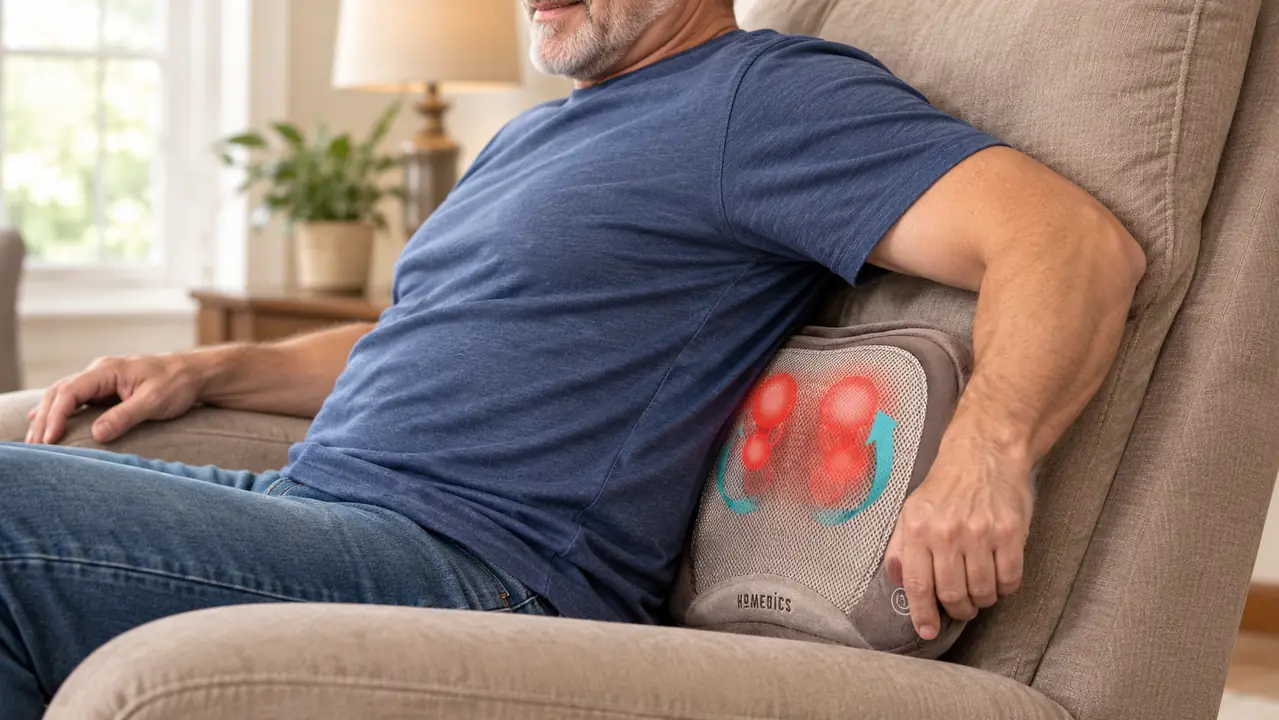
There is a permanent houseguest in my living room recliner, and it is a Homedics Shiatsu Back Massager. It has been sitting in that same chair since last fall, which is longer than most of my houseplants have lasted. I am sixty-three, retired after thirty-one years of teaching elementary art in Spokane, and I have a lower back that has been negotiating with me since a disc flare-up at fifty-eight. The cushion stays because it works, and because it does not ask anything of me. I turn on the heat, lean back, and let a machine do the part I cannot do for myself.
I am not a doctor and I will not pretend to be one. My back trouble started at fifty-eight, with a disc that made itself known during a summer of hauling furniture. My physical therapist got me through it with a set of exercises I still do most mornings, and she was clear that nothing you buy in a box replaces them. What a cushion can do is make the sitting part of the day less punishing. For a retired teacher who paints watercolors at the kitchen table, the sitting part of the day is most of the day.
Before this one, I tried the usual things. A rice-filled sock I heated in the microwave and draped over my hip until it went cold in eleven minutes. A heating pad with a cord that always seemed to be under Gary's feet instead of on my back. A chair insert with knobs molded into it that felt like kneeling on gravel. Two different handheld massagers that worked well enough and left my right hand and wrist sore from doing the work. I noticed a pattern. Everything I tried needed me to operate it, and the part of me that hurt was the part that had to hold it up.
The Homedics pillow solved that one problem first. It runs on a cord, so there is no charging and no fading out halfway through. The controls are built into the cushion itself, which sounds like a small thing until you have spent a year reaching for a cord that slipped behind the chair. Heat, speed control, and a bi-direction control that changes which way the kneading travels. I set it behind my lower back, lean into it, and my hands stay free. That is the entire reason it beat four other things I bought and returned.
My physical therapist gave me the exercises. This cushion gave me a reason to sit still long enough to let them help.
The fifteen minutes I stopped skipping
It lives in the recliner, runs on a cord, and does the kneading so my hands do not have to. If your back has opinions about your evenings too, this is where I would start.
Amazon Check Today's Price on Amazon →What it actually feels like is a pair of thumbs working in small circles. That is the shiatsu part, the circular kneading, and on the low speed it is gentle enough that I can read a page or two through it. The vibration adds more of a hum than a thump. On the higher speed I do not read, I just let it work and stare out the window at the maple tree. Ten to fifteen minutes is my limit before my back has had enough, and I would tell anyone the same thing. More is not better with this. It is a tool, not a way to spend an afternoon.
It has found a place in the rhythm of my weeks. Sunday mornings I sing alto in the church choir, which means standing through a rehearsal and then sitting on a pew built in a different century. Wednesday evening rehearsal ends the same way. So the recliner gets a session when I get home and my lower back has that hot, tired feeling on the right side. Same after the six hour drive to Boise to see the grandkids, although on those trips I am usually too glad to be out of the car to think about my back until the next morning.
Where It Helps Me and Where It Doesn't
Where it helps: the long, dull ache at the end of a day on my feet. The stiffness that shows up after two hours bent over a watercolor and I stand up like a question mark. The right-side knot that my therapist calls a guard pattern. Fifteen minutes in the recliner before I get up, and standing up is a different event than it was. That is the honest size of the benefit. It is not a cure and it is not dramatic. It is the difference between an evening that hurts and an evening that does not.
Where it does not help: anything sharp, anything new, anything that travels down my leg. That is a doctor conversation, not a cushion conversation. It also does not replace the exercises, and it does not fix the way I sit. It weighs 4.2 pounds, so moving it from the recliner to the kitchen chair is easy but not nothing. It needs an outlet, so in practice the recliner is where it lives. And it is 13.78 inches wide, which is enough to cover my lower back but not my whole spine at once.
The honest part, and I say this as someone who wanted it to be more than it is: it is a massage pillow. It is not a pair of hands, it does not know where your knot is, and you have to position it yourself. Some days I get it right on the first try. Some days I shift it three times before it settles. It also goes by the clock in my head, not by anything built in, so if you are the kind of person who forgets to get up, set a timer on your phone.

What I'd Tell You If We Were Sitting at My Kitchen Table
I would tell you to keep the appointment with your physical therapist first, and then I would tell you what I actually did. I stopped buying things that needed me to hold them. I put one corded cushion in the chair I already sit in, the one with the good light and the side table where my mug goes, and I gave it fifteen minutes before I stand up. That is the whole method. No schedule, no routine to remember, nothing to keep track of. If it is in the chair, I use it. If it were in a closet, I would not.
I would also tell you to be honest about what kind of pain you have. Mine is the dull, tired, right-side ache that comes from sitting and standing too long, and the Homedics cushion suits that. If yours is sharp, or new, or getting worse instead of better, that is a different conversation and a different appointment. I am sixty-three and I have learned the difference between a bad week and a warning. The bad weeks are what this chair is for. The warnings go to the doctor.
It's still in the recliner, eleven months later
No app to open, no schedule to keep, nothing to remember. Just a cord, a warm cushion, and fifteen minutes before you stand up. That was enough for me.
Amazon Check Today's Price on Amazon →