

Twenty minutes into a watercolor at my kitchen table, my lower back starts tapping me on the shoulder. It is not a sharp pain. It is a dull, hot pressure on the right side of my lumbar spine, and it has been part of my life since a disc flare-up at fifty-eight. I have tried the obvious things. I have sat on a heating pad until the timer clicked off and then sat on it some more, which is a mistake I will explain in a minute. I have also used it exactly the way my physical therapist told me to, and that version works. The pad I keep folded on the shelf beside my recliner is a Sunbeam XL, the 12 by 24 inch one, and this is what I have learned about using it without giving myself a second problem.
There is a lot of advice about heat and most of it is either vague or frightening. One person tells you heat is wonderful, another tells you heat is dangerous, and nobody tells you what to actually do at eight in the evening on a Tuesday when you cannot get comfortable. So here is the plain version, the one I would give a friend on the phone. It is not medical advice. I am a retired elementary school art teacher, not a doctor, and if your pain is new, severe, or getting worse, that is a call to your doctor or physical therapist before it is a call to your heating pad.
The pad I reach for when my back seizes up after choir practice
The Sunbeam XL measures 12 by 24 inches, so it runs across the whole lower back instead of landing on one spot and leaving the rest of the muscles cold. Four heat settings, a push-button controller with lights you can read in a dark room, and a 2-hour auto shut-off for the nights you drift off in the chair.
Amazon Check Today's Price on Amazon →Step 1: Know which pain heat is for, and which it is not
Heat is for stiffness, muscle spasm, and the kind of ache that settles in after a long drive or a cold morning in the choir loft. It is not for a fresh injury. My physical therapist was clear about the first forty-eight hours after something new happens: that is ice territory, because the tissue is inflamed and you are trying to calm it down. Heat on a hot, swollen, brand-new injury can make it worse. The same caution goes for a leg that feels numb, a leg that feels weak, and a back that started hurting after a fall. Those are doctor calls, not heating pad calls.
I also want to say the thing that took me a year to accept. Heat makes the ache quieter. It does not fix the reason the ache is there. If I use the pad and then sit in the recliner for three more hours, I feel worse by dinner than I did before I started. So before you plug anything in, decide what the heat is for. For me it is a fifteen minute window that takes the edge off enough that I can do the stretches my therapist gave me. That is the job. It is a good job. It is not the whole job.
If you are not sure which kind of pain you have, that is the answer to the question. Ask. I waited almost a year because I did not want to be a bother, and I spent that year guessing. A physical therapist sorted out in one appointment what I had been trying to figure out alone with a heating pad and the internet.
Step 2: Put a layer between the pad and your skin
Every burn I have ever heard about from a heating pad happened the same way. Somebody put it directly on skin, got absorbed in a show, and did not notice until it was too late. Older skin is thinner and slower to register heat, which is not a thing I knew at fifty and is very much a thing I know at sixty-three. So the pad goes over clothing, or under a thin towel, or under a light throw across your lap. Never bare skin, and never on a patch of skin that is already numb or has poor circulation, because you will not feel the warning in time to act on it.
The microplush surface on the Sunbeam is soft, and that softness is exactly why it is easy to forget it is running. That is a reason to be more careful, not less. I keep a thin cotton towel folded on the shelf next to the pad and it goes on first, every time, including the times I am in a hurry and telling myself it does not matter. It takes four seconds. I have also stopped wearing anything with a waistband that digs in while I am sitting with heat on, because a seam pressing into a sore spot for twenty minutes undoes most of the good.
Step 3: Start at the lowest setting and give it time
The Sunbeam has four heat settings, and the honest truth is that the highest one is not better. It is just faster to get uncomfortable. Start on the lowest setting, let it warm for a few minutes, and notice what your back says. If you are not feeling anything after five minutes, move up one setting. Most evenings I land on the second setting and stay there. My husband Gary, who has a different back and a different tolerance for heat, uses the third and thinks I am being dramatic.
The controller is a push-button with LED lights that show which setting you are on. Those lights matter more than they sound like they would. If you are lying in a dim room with your glasses on the nightstand, you can still see what you pressed, which means fewer accidental jumps to the top setting in the dark. I press the button, watch the light, and set the controller down on the armrest where I can reach it without twisting. Reaching behind me for a cord is its own small injury some evenings.
A word about the first minute, because this fooled me. The pad does not feel warm right away, and the temptation is to keep pressing the button until it does. Give it five minutes at a low setting before you decide anything. The listing says two heating elements, and mine warms from the middle outward, so the edges feel cooler at first. By the time I have finished a page of a book, it has evened out.

Step 4: Position it flat against the lower back, then settle in
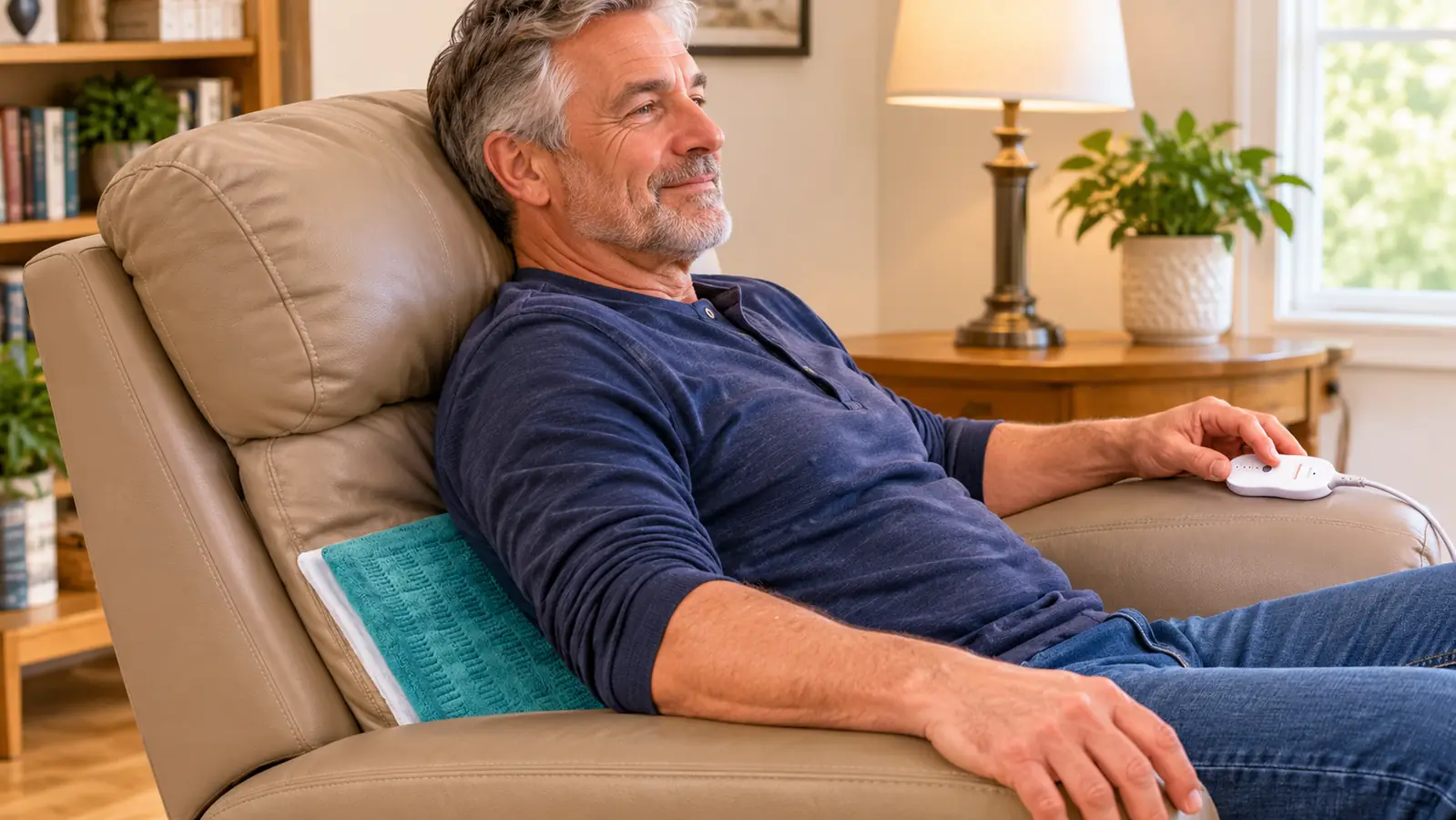
The pad is 12 by 24 inches, which is the reason I chose this one over a smaller square. The 24 inch length runs across the whole lower back rather than landing on one spot and leaving the rest of the muscles cold. Position matters as much as heat. It should lie flat against your back, not bunched into a fold, because a fold traps heat in one small place while the rest of the pad does nothing.
My setup is the recliner. I sit back with my feet up, put the pad across my lower back, lean into it, and pull a light throw over my lap so the whole arrangement stays where I put it. On the bad nights I use the bed instead: firm queen mattress, on my side, pillow between my knees, pad tucked against the sore side under my shirt. What does not work is lying on my stomach on the floor with the pad underneath me. I tried that exactly once. The heat was fine. Getting back up was not, and Gary had to help, which he has not let me forget.
Step 5: Use the shut-off as a backup, not as your plan
The pad has a 2-hour auto shut-off, and that is a safety net, not a schedule. Fifteen to twenty minutes is a session. Twenty minutes of heat, then get up and move. If you leave it running for the full two hours because it feels good, you are not doing your back any favors and you are risking a burn that does not announce itself the way a stove burner does. I set the kitchen timer. The shut-off is the backup for the times I forget, not the thing I rely on.
Check your skin when you are done. It should be pink and warm, the way it feels after a hot shower. If it is bright red, or if there is tenderness you did not have before, you had it too hot or too long. Take a break from heat for the rest of the day, and if the redness does not fade, make a call.
The last part is the one I resist. After the twenty minutes, stand up and walk. Ten minutes around the block, or down the hall and back if the weather is doing what Spokane weather does in January. The heat loosens the muscles and the walking tells them what to do with the looseness. Heat on its own is a warm pause. Heat plus a short walk is the thing that actually changes how the evening goes, and I can tell the difference by nine o'clock whether I did it or not.
What Else Helps
The recliner is not a neutral object. If yours is like mine, it has a soft spot that lets your hips sink lower than your knees, and that shape is hard on a lumbar spine over an hour. A rolled towel behind the small of my back, or a firm cushion under the seat, changes how the whole evening feels. So does where you keep the pad. Mine lives folded on the shelf beside the chair, not in a drawer across the room, because a heating pad you have to fetch is a heating pad you skip.
The other things that have helped me are unglamorous and none of them are interesting. Walking daily, even when it is cold. The four stretches my physical therapist gave me, done on the days I feel fine, not only on the days I hurt. Sleeping on a firm mattress with a pillow between my knees. Standing up from the kitchen table every half hour when I am painting, because two hours hunched over a watercolor is two hours my back pays for later. And the six-hour drive to Boise to see the grandchildren goes better with a stop every ninety minutes to walk around a gas station, whether or not I want to.
I will also say that a heating pad is a tool with one setting worth owning, and that is comfort. It will not strengthen anything. It will not buy you a stronger back. What it does is buy you twenty minutes of enough relief that you can do the boring exercises that do strengthen it. The pad has a 5-year limited warranty, which tells you Sunbeam expects it to last, and mine has been dropped on a hardwood floor more than once and still works. What it will not do is tell you when to see a doctor. So I will: if the pain runs down your leg, if you feel numbness or weakness, if your balance changes, or if the pain wakes you at night and is worse when you rest, that is not a heating pad problem and it needs a professional opinion. Mine did, at fifty-eight, and I am still glad I went.
Twenty minutes of heat, then get up and walk. The pad is the warm-up, not the fix.
Four settings, one I actually use, and a shut-off I trust more than my own memory
The Sunbeam XL is 12 by 24 inches with a microplush surface and a push-button controller you can read in a dark room. It cuts itself off after 2 hours, so drifting off in the recliner with it on is not the disaster it would be otherwise. It comes with a 5-year limited warranty.
Amazon Check Today's Price on Amazon →