

Last spring I drove to Boise to see my grandchildren and stepped out of the car walking like a woman twenty years older than I am. Six hours in the driver's seat and my lower back had gone from the dull ache I live with to something that made me hold the door frame until it passed. Here is the part that still bothers me: I had a lumbar cushion in the car the whole way. I had simply put it in the wrong place. That is the thing nobody tells you about these pillows. The pillow is rarely the problem. Where it sits is the problem.
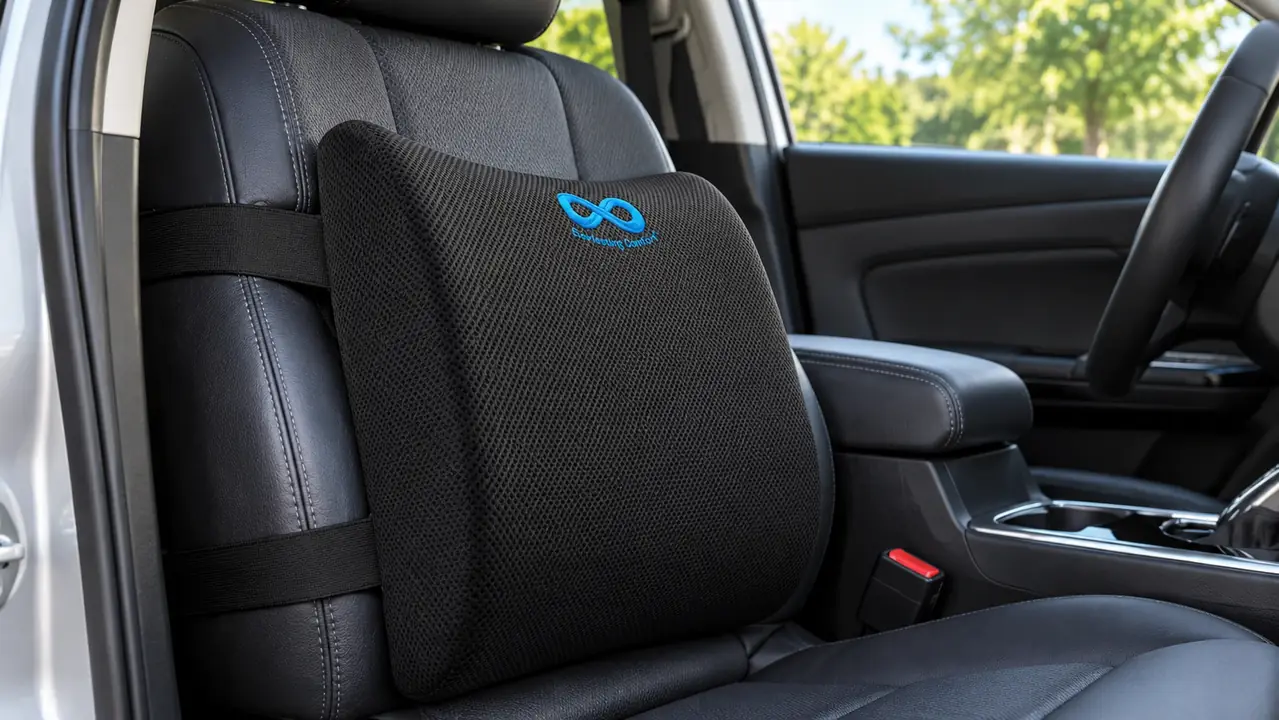
The one that lives in my car now is the Everlasting Comfort Lumbar Support Pillow, and I want to be straight with you about what it is before we get to the setup. It is a rectangular memory foam cushion, 13 inches long, 3.5 inches deep and 12.6 inches tall, and it weighs a pound and a half, which means I can carry it from the car to the kitchen without thinking about it. The cover comes off for washing. It has dual adjustable straps with extension pieces, and those straps turn out to matter more on a kitchen chair than they do in a car. None of that is the reason it works, though. It works because the foam gives you something to position against.
The cushion is only half the job. The other half is where you put it.
The Everlasting Comfort Lumbar Support Pillow is the one I keep in the car and carry to the table. Memory foam, a removable cover, and straps with extension pieces long enough to reach around most chair backs. Today's price is on the listing.
Amazon Check Today's Price on Amazon →Before You Start: Two Things Worth Checking
First, if your pain is new, sharp, or getting worse rather than better, put this article down and call your doctor or a physical therapist. I am a retired elementary school art teacher, not a clinician, and nothing here is medical advice. What I know is what a physical therapist taught me about my own back after a disc flare-up at 58, plus four years of trial and error at my own kitchen table. Second, understand what a lumbar cushion can and cannot do. It does not treat a disc. It does not strengthen anything. It holds your lower back in the shape it already makes when you stand up straight, so that sitting does not flatten it out.
That is the whole mechanism, and once you understand it the setup stops being mysterious. Your lower back has a natural inward curve. Sitting, especially in a soft chair or a car seat with the seatback reclined a little, flattens that curve and puts the load on parts that were not built to take it. A firm cushion fills the gap so the curve stays. Too high and it pushes on your mid back and does nothing useful. Too low and it just makes the seat shorter. So the first job is not strapping anything down. The first job is finding the spot.
Step 1: Find the Small of Your Back Before You Move Anything
Stand up and put your hand on your lower back, palm flat, fingers pointing across. Slide your hand down until the curve turns inward and then flattens toward your hips. That inward hollow is the target. On me it sits roughly level with the top of my hip bones, maybe an inch above. On my husband Gary it is higher. Yours is wherever it is, and no article can hand you the number.
Now sit in the chair you actually use and find that same spot again. Your hand will tell you something useful: in most car seats and kitchen chairs, that hollow ends up somewhere between two and four inches above the seat cushion, depending on how far back you recline and how tall you are. That is the number you are aiming for, and it changes everything. When I first put my cushion in the car, I set it so the bottom edge rested on the seat. The thickest part of the foam ended up under my ribs. I spent six hours being pushed forward at the shoulders and blaming my back instead of my setup.
Step 2: Set the Height in the Car Seat
Do this with the car off and parked, and give yourself ten minutes. Sit the way you actually sit when you drive, not the way you sit for a photograph. For me that means the seatback angled back a little and my hands at nine and three.
Hold the cushion against the seat back and slide it up or down until the thickest part of the foam sits in the hollow you found in Step 1. Then lean back against it and pay attention to three things. Whether you feel contact all the way down your lower back rather than one pressure point. Whether your shoulders are still resting on the seat back instead of being pushed off it. And whether your chin is level. If your chin is up, the cushion is too high and you are being pushed into a straight-backed posture your back did not ask for.
Now the straps. The Everlasting Comfort cushion has dual adjustable straps with extension pieces, and in the car I run them around the seat back at shoulder height rather than behind the seat. Threading them through the gap and clipping behind the seat back works too, and it holds better on leather. What I do not do is cinch them tight enough to compress the foam. The straps are there to keep the cushion from walking sideways when you get in and out, not to squash it into the seat. Snug is enough.
Step 3: Make It Stay Put on a Kitchen Chair
The kitchen chair is harder, and it is where most people give up. My chair at home has a flat wooden back with a slight curve and a seat that is thinner than a car seat, so the cushion sits against it at a different angle. Here is the order that worked for me.
First, sit down and find your hollow with the pillow out of the way. Second, set the pillow so the thickest part meets that hollow, which on my chair means the bottom edge hangs about an inch and a half below the seat surface. That looks wrong. It looks like it is sliding off. It is not, because of the straps. Third, use the extension pieces and run the straps around the chair back. If your chair back is open, run them around the uprights instead. If your chair has no back at all, a stool or a bench, tuck the bottom of the pillow behind you and accept that you will reposition it every time you sit down.
One more thing about the kitchen chair. Because the pillow is 3.5 inches deep, it moves you forward on the seat by roughly that much. On a chair that was already a little short front to back, that means less thigh support. I noticed it in the first week and fixed it by sliding the chair two inches closer to the table. Small adjustment, but it stopped me from perching on the front edge, which was worse for my back than no pillow at all.

Step 4: Adjust the Depth, Not the Height
Once the height is right, most people stop. Do not stop. The other variable is how much of the foam you are actually pressing into, and you can change that without moving the pillow at all.
Memory foam compresses where you push and stays firm where you do not. If the cushion feels like a lump, you are sitting too far forward against it and using only the front face. If it feels like nothing, you have leaned back so the foam has taken your shape and you are no longer getting support, which happens on long drives. What I do on the highway is this: every hour or so I sit up, let the foam come back, and settle against it again. It sounds fussy, it takes four seconds, and it is the difference between arriving in Boise stiff and arriving able to carry a suitcase.
The pound and a half weight matters here more than you would think. A heavier cushion stays where you put it but is a nuisance to move. This one is light enough that I carry it into the choir rehearsal room on Wednesday nights and put it on a folding chair, and light enough that I do not resent carrying it back out to the car afterward. The removable cover has been through the wash a dozen times at this point and has not pilled.
Three inches. That was the entire difference between a cushion that helped me and a cushion that made my back worse.
Step 5: Give It a Week and Change One Thing at a Time
This is the step I skipped for a month and regretted. When you change your sitting position, your back notices, and it does not always send a thank-you note. My first three days with the pillow at the right height felt strange, almost like being corrected by a teacher. My mid back was working a little harder because it was no longer slumped. By day five that settled. By day ten I stopped thinking about it, which is the highest compliment I can pay a piece of furniture.
So change the height, then leave it alone for a week. Write down what you notice, and I mean actually write it on paper, because you will not remember. Mine said things like Tuesday, drove to the store and back, no ache getting out. And Thursday, two hours painting, stood up without holding the table. After a week, if something still bothers you, change one thing. The height. The strap tension. The depth. Then another week. If you change three things at once you will never know which one worked, and you will end up where I was, with a good cushion in the wrong place and a bad opinion of it.
What Else Helps
A cushion is one tool. It is not the whole toolbox, and I would be doing you a disservice to pretend otherwise. The things that have helped me most alongside it are unglamorous. Standing up every thirty to forty minutes, which on a long drive means planning stops before my back demands them rather than after. Walking. My physical therapist gave me a short set of movements that take five minutes, and I do them on the days my back is cranky rather than on the days it is fine, which is backwards and I know it.
In the car specifically, the seat angle matters as much as the pillow. A seatback reclined too far puts more weight through your lower back. Too upright and you are holding yourself up with your muscles instead of the seat. Somewhere around 100 to 110 degrees works for me, which is roughly two fingers of recline past straight. And the lifetime replacement guarantee on the Everlasting Comfort cushion is worth knowing about, not because I have needed it, but because it tells you something about how the company expects the foam to hold up. Mine is over a year old and still returns to shape after a drive.
The last thing, and this is what I would tell a friend: the pillow does not have to live in one place. The straps and the extension pieces mean it moves. Car, kitchen chair, the recliner in the living room on evenings when my back is complaining, the folding chair at choir. If it lives in a closet, it is not helping anybody.
Set it up once in the car, once at the table, then forget about it.
The Everlasting Comfort Lumbar Support Pillow is memory foam, 13 by 3.5 by 12.6 inches, 1.5 pounds, with a removable cover and dual adjustable straps that reach around most chair backs. Today's price is on the listing.
Amazon Check Today's Price on Amazon →