

Before you buy anything for your back, try the rolled towel. My physical therapist suggested exactly that a few years ago, after the disc flare-up that started all of this, and she was right. A bath towel, rolled tight and tucked into the curve of your lower back, takes about ninety seconds to make and it does real work. I used one for the better part of two years: in the car, at my kitchen table, in the recliner.
Then I bought the Everlasting Comfort Lumbar Support Pillow and used it for months in those same chairs and on the same six-hour drive to Boise to see my grandchildren. Here is the short answer. The towel is the better thing to try first. The pillow is the better thing to live with. The reason has almost nothing to do with how either one feels in the first five minutes.
The difference arrives around the ninety-minute mark. A towel starts out as whatever you rolled it into and finishes the drive as something flatter and harder than you made it. The Everlasting Comfort pillow is memory foam with a removable cover and two adjustable straps with extension pieces, and at hour four it is still doing the job it was doing at minute four. That is the whole comparison in one sentence. What follows is the detail.
| Everlasting Comfort Lumbar Pillow | A Rolled Bath Towel | |
|---|---|---|
| Staying where you put it | Two adjustable straps with extension pieces hold it against the chair back, so it does not slide down | Nothing holds it in place. It rolls out of position every time you stand up |
| Support at hour four | High-density memory foam keeps its shape through a long drive | Compresses flat and hardens as your own body weight works on it |
| Dialing in the exact thickness | One shape, one firmness. You take what the foam gives you | Roll loose, roll tight, switch towels, add a second one. Total control |
| Washing it | The cover zips off and goes in the machine. The foam core does not | The whole thing goes in the machine and the dryer |
| Packing for a trip | 13 inches by 12.6 inches by 3.5 inches, 1.5 pounds. It takes up room in a suitcase | Flattens to nothing, or borrow one at the other end |
| Trying it before you commit | You buy it to find out whether it suits your back | You already own one, so there is nothing to buy |
| Holding up over the years | Backed by a lifetime replacement guarantee | Towels wear thin and end up in the garage rag pile |
| A long evening in the recliner | Works, though the straps have nothing to grab onto on a soft back | Works, and you can shift it as you change position |
I did not expect that table to come out as even as it did. Four rows go to the towel, three go to the pillow, and one is a genuine tie, which is roughly what my back has been telling me for two years. So let me take the two columns apart and say where each one actually earns its place.
Where Everlasting Comfort Wins
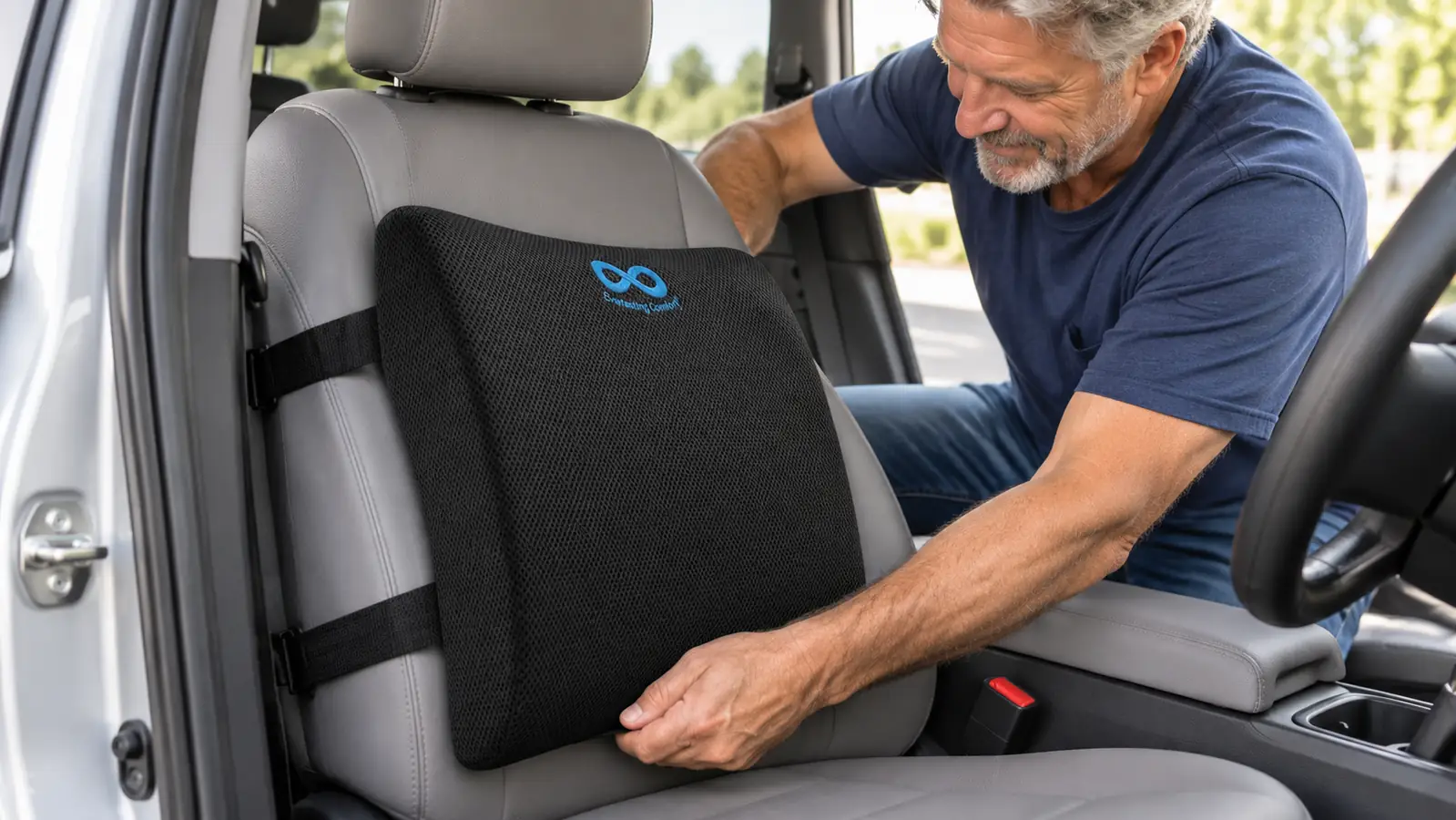
The single thing that ended the towel era for me was the straps. Two of them, adjustable, with extension pieces long enough to reach around the back of a car seat or a dining chair, and they hold the pillow where you put it. A towel has no such arrangement. You tuck it in, you sit down, you stand up twenty minutes later to refill your coffee, and it has rolled down and sideways into the small of your back. Over a six-hour drive that happens four or five times, and each time you are re-rolling a towel one-handed at highway speed, which is not a thing I recommend. The drive where I gave up on the towel for good was in October, on the straight stretch of Highway 395 south of Ritzville. I had re-rolled it three times before we crossed the state line and once more outside Pendleton. By the time we stopped for lunch I had wedged it under the seat and sat the last two hours with nothing behind me at all.
The second win is firmness over time. High-density memory foam holds its shape and a towel does not. By the end of a long drive a towel has been compressed by your own body weight into a thin, hard roll that pushes into your back instead of filling the curve of it. The pillow is still a pillow. That matters more than any line on a listing, because the entire point of the thing is what it does at hour four rather than hour one. I notice it most in the recliner now, where a towel used to need re-folding twice before the evening news was over.
The third advantage is that it moves. The listing calls it lightweight and portable, and at 1.5 pounds that holds up. Mine has been on a kitchen chair, in the passenger seat of the car, on the couch during a movie, and on a folding chair at choir rehearsal on a Wednesday night, which is the hardest seat in the building. A towel would have to be re-rolled at every one of those stops. The pillow just goes with me.
Where a Rolled Towel Wins
Adjustability is where the towel quietly beats the pillow, and I do not want to undersell it. A towel lets you control thickness exactly. Roll it loose, roll it tight, switch to a thinner towel, add a second one, fold it in thirds and work the fold into the curve. If your back wants something specific, and mine does, right side worse than left, a towel can be made to match it in a way that one molded shape cannot. That is worth a great deal in the first month, while you are still working out what your back actually wants.
It also wins the unglamorous categories. A towel goes in the washing machine whole. The Everlasting Comfort cover zips off and washes fine, but the foam core stays out of the machine, so the surface you lean on every day gets spot-cleaned rather than laundered. And a towel packs. When we drive to Boise the trunk is already full of watercolor supplies and gifts for four grandchildren, and something that flattens to nothing is welcome company. The pillow is 1.5 pounds and about the size of a small cushion. Not heavy. Still a thing to carry.
There is a subtler win, too. The towel taught me what my back wanted. Two years of rolling and re-rolling, looser here and tighter there, and I arrived at the pillow already knowing that I like support low and firm rather than high and soft. Without that education I would have spent the first month with the pillow in the wrong spot and blamed the pillow. If you are starting from zero, a towel is good tuition.
If your towel is flat by the second hour, this is the next thing to try
Two adjustable straps with extension pieces hold it against the chair back, and the memory foam keeps its shape through a long drive. I keep one on the kitchen chair and one in the car.
Amazon Check Today's Price on Amazon →What the Pillow Actually Is
The Everlasting Comfort lumbar pillow is a rectangular cushion, 13 inches long, 3.5 inches deep and 12.6 inches tall, filled with high-density memory foam and covered in a breathable, latex-free fabric that zips off for washing. It weighs 1.5 pounds. The listed features are adjustable, compressible, portable and removable cover, and the manufacturer backs it with a lifetime replacement guarantee. That is the entire object. There is no pump, no dial, no extra mode to learn. You position it, you pull the straps snug, and you sit down.
The size is worth thinking about, because this is not a small pad. Twelve and a half inches tall covers a good stretch of your back instead of one spot, and three and a half inches deep pushes you forward a little, which you will either want or not want. In the car I slid it down so the top edge cleared the headrest, and that was the only fiddling it needed. In the recliner the straps had nothing useful to grab, so it simply sat behind me, which was fine. It moves between the kitchen chair and the car easily enough that I stopped thinking of it as belonging to one place. One thing to know before you buy: three and a half inches of foam against a chair back changes your seat depth by that much. On a dining chair that felt right. On the recliner it pushed my knees too far forward some evenings, so I turned it sideways and used the long edge instead, which sat lower and suited me better.
How I Compared Them
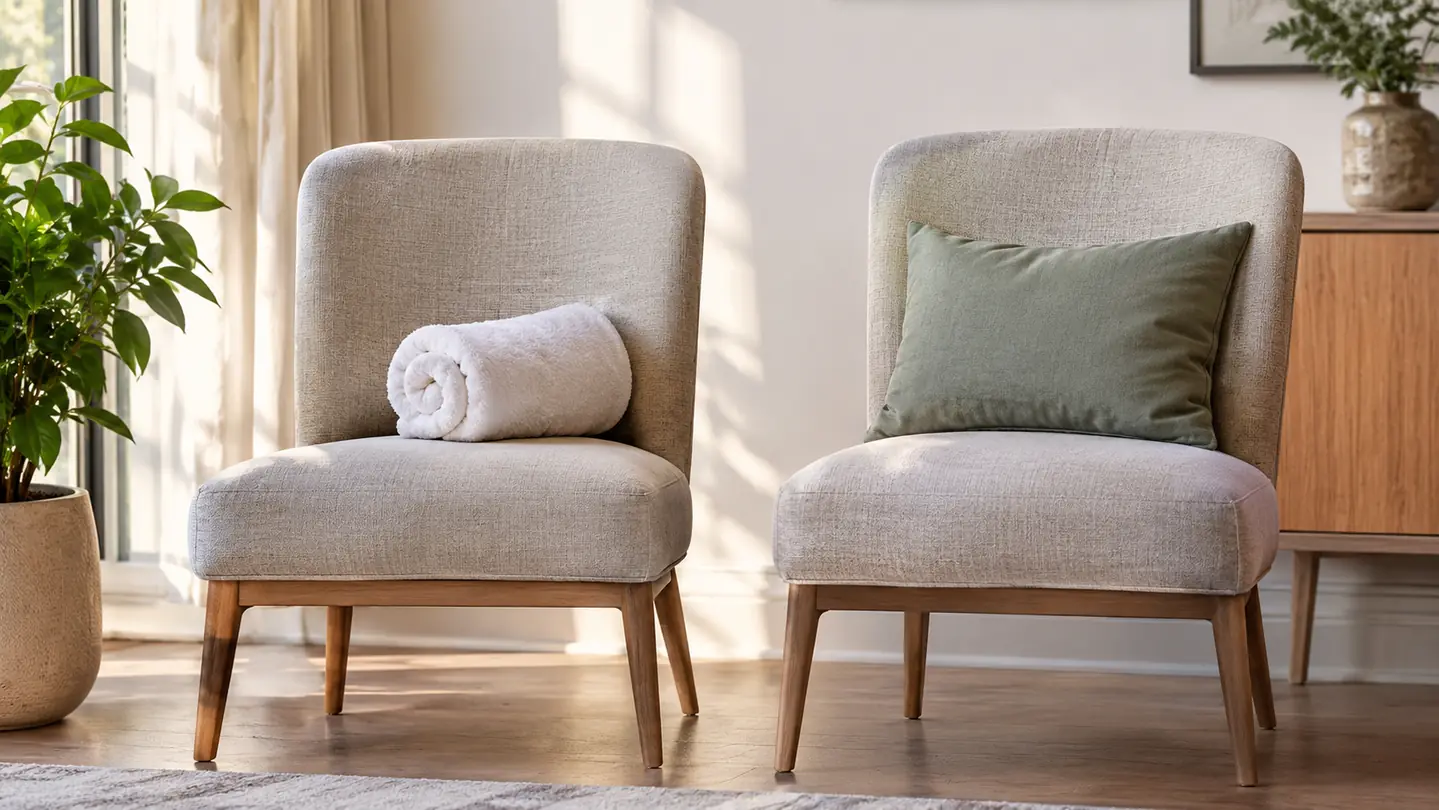
I am not a doctor and I do not play one here. I am a retired elementary school art teacher in Spokane with a lower back that has complained since a disc flare-up at fifty-eight, managed with a physical therapist and no surgery. Everything in this piece is one person's experience in one house. What I did was simple. Same chairs, same car, same six-hour drive to Boise. Roughly a month with a towel, then several months with the Everlasting Comfort pillow, and I paid attention to when each one stopped working rather than when it started. The towel month was February, when I am indoors most mornings with the paper and the crossword. The pillow arrived in March and I ran the same routine with it: the Wednesday rehearsal chair, the grocery run, the desk by the window. Then I put both of them in the car for the April drive to Boise and paid attention the whole way.
The other thing I did was quit judging by the first five minutes. Both of them feel fine in the first five minutes. A folded sweatshirt feels fine in the first five minutes. The useful question is what is behind your back at hour three, and that is where these two part company. Any new, severe or worsening pain is a conversation for your doctor or physical therapist, not for a cushion review, and I mean that.
One more note on method. I did not measure anything. No angle gauges, no pain scores written in a notebook. I am reporting what I noticed over weeks, which is what most people actually have to go on. Where I mention a number it is either from the listing or from my own odometer.
By the end of a long drive a towel has been compressed by your own body weight into a thin, hard roll that pushes into your back instead of filling the curve of it.
What Neither One Fixes
Neither of these is a treatment. A cushion changes what your back is resting against. It does not strengthen anything, it does not loosen anything, and it will not undo a morning spent folded over a watercolor easel. My physical therapist was blunt about this. The support buys you enough comfort to sit long enough to do the exercises, and if you skip the exercises you have bought a nicer way to sit badly. I still do the exercises. I still get out and stand beside the car for a minute on a long drive.
The other thing neither one fixes is a chair that is wrong in some other way. If the seat pan is too deep or the screen sits too low, a lumbar roll is a patch on a bigger problem. What it does is remove one of the complaints, and removing one complaint is often enough to make the rest of them visible. That is not nothing. It is just not everything.
Who Should Buy Which
Buy the pillow if your problem is a long sit. If you drive more than an hour at a stretch, or you are at a desk or a kitchen table all morning, or you get up and sit back down twenty times a day, the straps and the foam are worth having. Buy it if you have already tried the towel and found yourself re-rolling it halfway through the afternoon. Buy it if you want the same support in the car, the kitchen and the living room without making a fresh towel roll for each one.
Start with the towel if you have not tried it. You already own one, it takes a minute, and it will teach you what thickness and what height your back actually wants before you commit to a shape you cannot change. If a tight roll feels good and a loose one feels bad, you have learned something worth knowing. If a towel holds up all evening and you never think about it again, you may not need the pillow at all, and I would rather say so than talk you into something. What I would not do is buy the pillow first and keep the towel in the closet out of loyalty. Use whichever is behind your back at four in the afternoon. That is the only test that ever told me anything.
The one that is still doing its job at hour four
Memory foam that holds its shape through a six-hour drive, two adjustable straps with extension pieces, and a cover that zips off for washing. Backed by a lifetime replacement guarantee.
Amazon Check Today's Price on Amazon →