
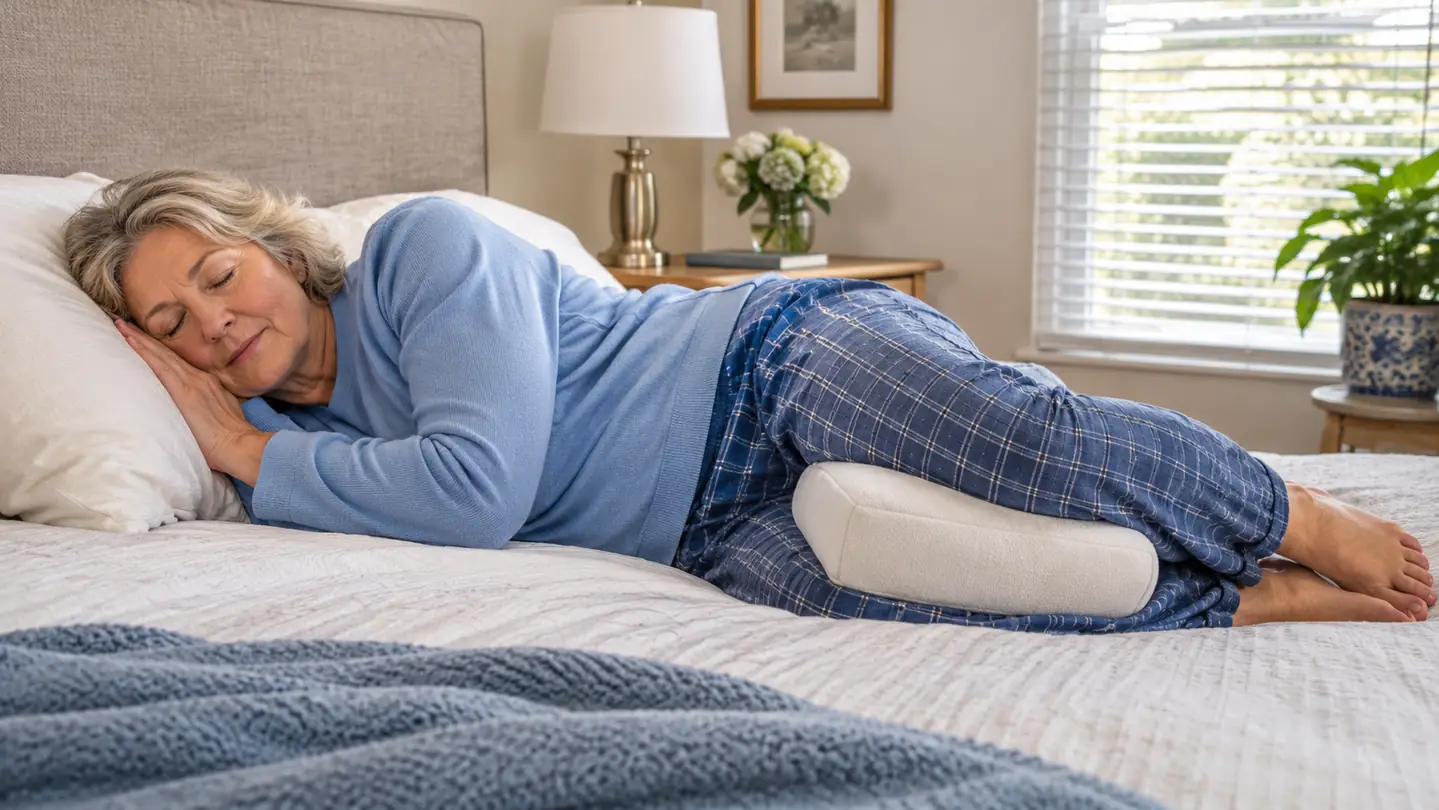
I am 63, a retired elementary school art teacher in Spokane, and I have slept on my side for most of my adult life. I also have recurring lower back pain on the right side, ever since a disc flare-up when I was 58. My physical therapist gave me exercises, I do them faithfully, and I am not pretending a pillow replaces any of that. But after months of waking at 4 a.m. with a stiff lower back, I wanted a straight answer to a narrow question: would the Contour Legacy Leg & Knee Foam Support Pillow make side sleeping easier on my back, or would it end up on the floor by 2 a.m. like everything else I had tried? I have used it for about four months now, on my own firm queen mattress, in the same single-story house where I paint watercolors at the kitchen table and sing alto in the church choir. This is what I found, plainly.
I did not order it expecting a transformation. I expected foam to slide out from between my knees and land on the rug. That had happened with a regular bed pillow I bunched up and shoved between my knees, and with a rolled towel before that. The Contour pillow stayed put better than either, though not perfectly. The bigger difference was how it held my top leg. When my top knee drops forward, my hip rotates and my lower back takes the load, and I could feel that pull ease when the pillow stayed where I put it. That is a small thing to write down, but it changed how I got out of bed in the morning.
The Quick Verdict
A soft, washable memory foam leg pillow that made side sleeping easier for my lower back, with the honest caveat that it took a few nights to position and it is not a cure.
Amazon Check Today's Price →The First Night I Woke Up Without a Stiff Lower Back
I am not going to pretend this pillow fixed my back. What it did was make the between-knees position easier to hold all night, which is exactly what my physical therapist wanted me to practice. If you are a side sleeper with a finicky lower back, this is the version I would start with.
Amazon See the Contour Legacy on Amazon →How I've Used It
I started with the Contour Legacy on a Monday night in March, the day after a Sunday choir rehearsal that left my right lower back cranky from standing. I slid it between my knees so the length of it ran along my legs, which is the position that felt stable to me, and went to sleep. The first two nights I woke up once each and had to fish it back into place with my heel. By the fourth night I had stopped doing that. I am a restless sleeper. I turn from my right side to my left two or three times a night, and the pillow came with me more often than the bunched-up bed pillow ever did.
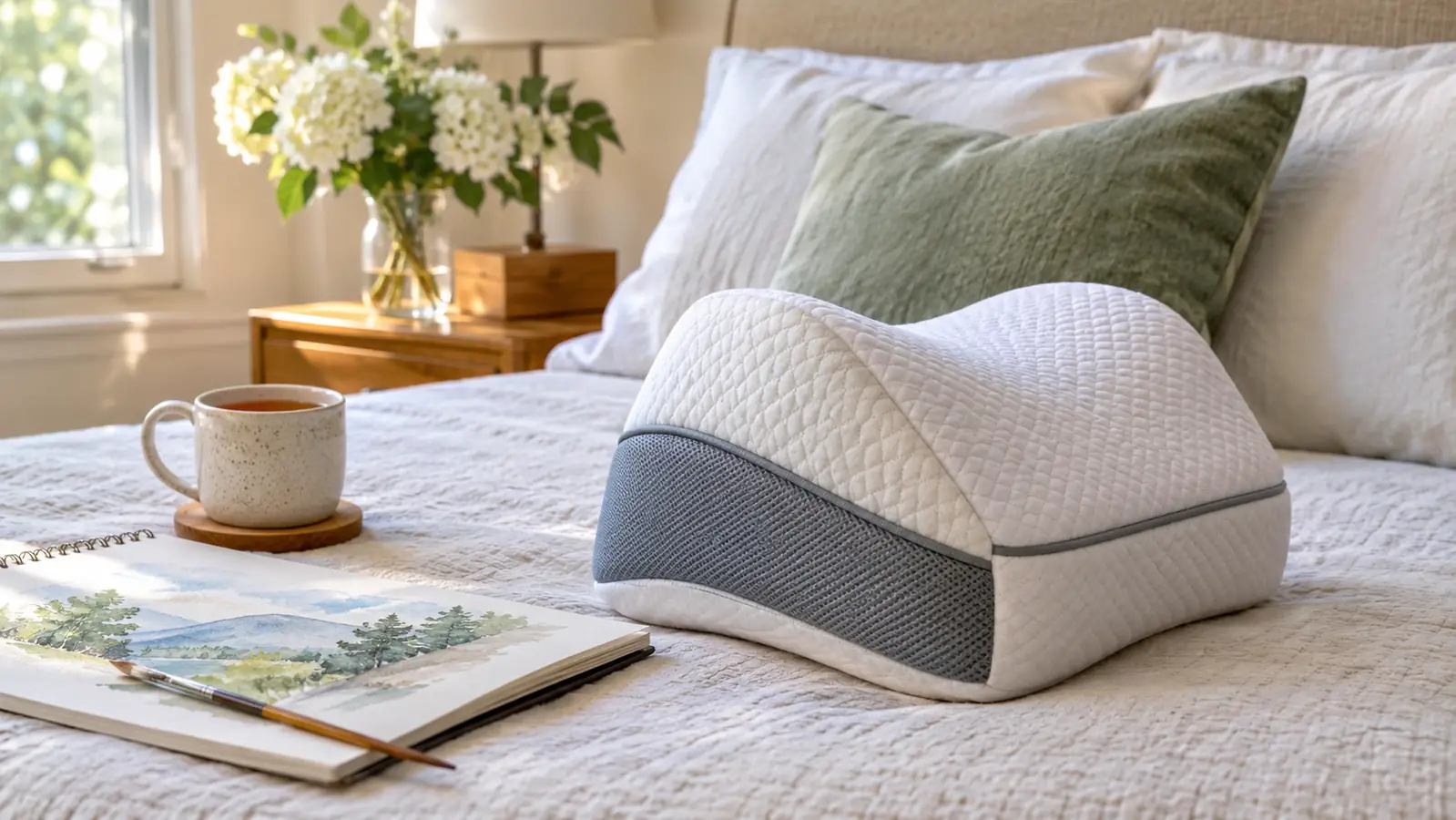
During the day it lives on the foot of the bed or on the hope chest near the window. It is 10 inches long and 9.5 inches wide, and it weighs 198 grams, so I can move it with one hand when I make the bed. I washed it once according to the care instructions and let it air dry, and it came back to its shape. The fabric is 62 percent polyester and 38 percent Lyocell, and it feels cool when I first get in. I am not a hot sleeper, but I notice when a pillow traps heat behind my knees. This one did not.
Before I ordered the Contour, I spent most of January and February working through the cheaper versions of the same idea, and I want to be honest about why they failed. First was a bath towel rolled tight and held with a hair elastic. It felt fine going to sleep and was flat by 3 a.m., and I would wake with a crease pressed into the side of my knee. Second was a standard bed pillow bunched in half. That one had the opposite problem. It was bulky enough that my knees sat too far apart, which pushed my top hip into a stretch and left me aching on the outside of the joint by morning. Third was a foam wedge that had been in the hall closet for years. Too firm, too tall, and it made my knee throb. None of those three cost me much and none of them lasted a week. What the Contour has that they did not is a shape made for the job and foam soft enough to give under a knee without collapsing.
What the Contour Legacy Does Differently
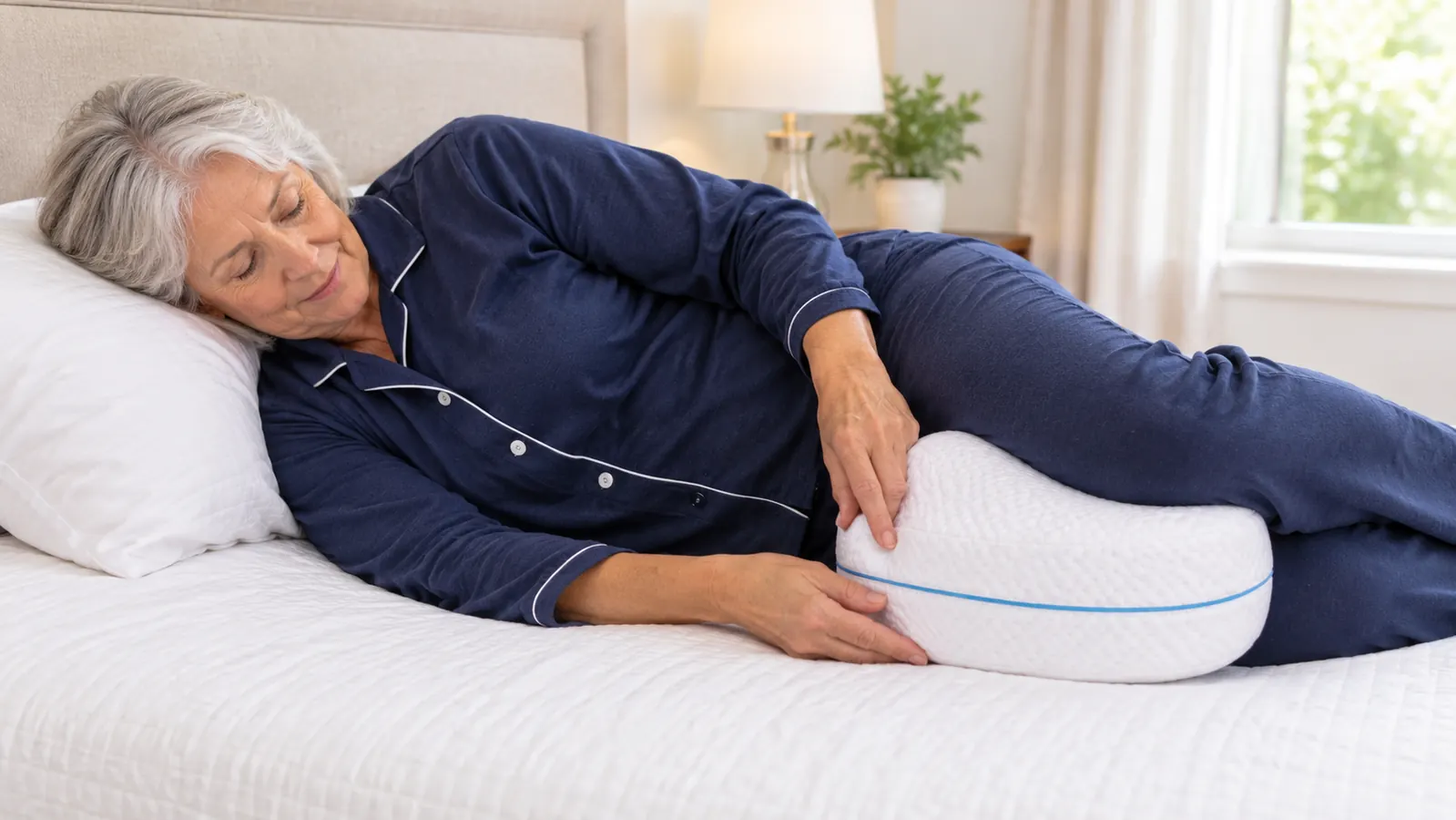
The main thing is that it supports both legs and knees at once, which is the claim Contour has been making since it first made this style of pillow in the early 1990s. I cannot verify the history and I am not going to pretend I can. What I can tell you is what the shape does for me. It keeps a gap between my knees instead of letting the top knee drop forward. When my top leg drops, my hip rotates and my lower back takes the load. With the pillow in place, that drop is smaller. I still turn. I still have bad nights. But the bad nights are less frequent.
The foam is memory foam rated soft, and it gives under my knees without going flat. I was worried it would be too soft and I would sink straight through to my knee bones. It is soft, but it has enough structure to keep my knees apart, which is a harder combination to find than it sounds. Contour also says the foam is temperature regulating, designed to push heat away from the body. I cannot measure that and I would not trust anyone who says they can. I can say I did not get the damp, hot feeling I sometimes get with foam. That is enough for me.
I also like that using it is simple. I slide it between my knees and go back to sleep. Gary is a back sleeper and tried it once for his knees. He handed it back and said it felt like sleeping with a book between his legs. Fair enough. It is not for him. I did not need instructions and I did not have to fuss with anything in the dark, which matters at 2 a.m. when you are half awake and would rather not be awake at all.
I have had cheap foam pillows go soft in the middle within a couple of months, and that has not happened here. Four months of nightly use and the surface still springs back when I press it with my palm. Contour lists a one year customer care warranty on the product, which I have not needed to use, so I cannot tell you how the company handles a claim. I can tell you the pillow I have is doing the same job in July that it did in March. That was the part I was least sure about when I ordered it, because a pillow that only works for six weeks is worse than no pillow at all.
What Four Months Actually Changed
The first two weeks were an adjustment. My hips felt slightly achy in the morning, the way they do when I start a new exercise. My physical therapist had warned me that changing sleep position can feel odd at first, and she was right. By week three that ache was gone. The change I noticed most was at 5:30 a.m., when I swing my legs over the side of the bed. Before the pillow, I often sat there for a minute and let my lower back settle before I stood. Now I still take a moment, but I am not bracing myself. That is the honest version, no more and no less.
I also noticed it helped on the nights after choir practice. Standing for an hour and a half on a Sunday morning, then sitting in the car, then coming home to paint at the kitchen table, used to leave my right side tight. I started using the pillow on those nights even when I was not particularly sore, and it seemed to keep the tightness from settling in overnight. I cannot prove that. I can only tell you what the pattern looked like over four months.
There is one Tuesday in late April I keep thinking about. I painted for nearly three hours on a watercolor of the Palouse hills, which for me means sitting at the kitchen table on a stool, leaning in close, then getting up every few minutes to rinse a brush. I did not think about my back once until I stopped. That night I went to bed with the dull ache I usually get after a long session, and I remember lying there waiting for it to build into something worse. It did not. I woke at my normal time without the braced feeling. Maybe that would have happened anyway. But it had not happened in April the year before, and I noticed.
The pillow did not fix my back. I still do my exercises. I still see my physical therapist every few months. I still have days when I overdo it in the garden or sit too long at the easel and pay for it. What the Contour Legacy did was remove one small source of strain from my night. That is not nothing. Sleep is when your body settles, and if you are twisting your hips all night, you are not giving it a fair chance.
In June I drove the six hours to Boise to see our grandchildren and packed the pillow in my suitcase. It weighs 198 grams and takes up less space than a pair of jeans. The first night in our daughter's guest room I did not use it, mostly because I was tired and forgot, and I woke up stiff on the right side. The next three nights I used it and slept the way I sleep at home. I am not going to claim a pillow changes a vacation, but it fit in the bag without a fight, and that is more than I can say for the foam wedge still sitting in my closet.
The change I noticed most was at 5:30 a.m., when I swing my legs over the side of the bed. I was no longer bracing myself for the first step.
The Parts I Do Not Love
It is not perfect. On very warm nights the foam still feels like foam. It is better than the old bed pillow, but it is not the same as sleeping with nothing between your knees. I also wish it were a little wider. At 9.5 inches wide it fits me fine, but if you have very long legs or broad hips you may want more surface. My knees are average, and I still sometimes wake up with one knee half off the pillow.
The bigger caveat is that it takes time to learn your own position. The first three nights I was awake more than usual, adjusting it. If you give up after one night you will probably decide it is not for you. I would give it a week, minimum. Also, it is a side-sleeping tool. If you sleep on your back it will probably just be in the way. Gary's reaction was not a fluke. This is not a universal pillow, and anyone who tells you otherwise is selling something.
The washable fabric is a plus, but it is still foam, so you cannot toss it in the dryer on high and expect it to come out the same. I washed it once and let it air dry for a full day. That is a small inconvenience, not a deal breaker, but I would rather know it going in than find out at ten o'clock at night with a damp pillow in my hands.
What I Liked
- Keeps a gap between the knees, which eased the pull in my right hip on side-sleeping nights.
- Soft memory foam holds its shape and did not flatten out over four months.
- Washable fabric and light 198 gram weight make it easy to move and clean.
- Stayed in place better than a bunched-up bed pillow, even when I turned.
Where It Falls Short
- Took about a week to learn how to position it without waking up.
- At 9.5 inches wide, it may be too narrow for very long legs or broad hips.
- It is a side-sleeping tool only; back sleepers will likely find it useless.
- Foam can still feel warm on hot nights.
Who This Is For
This is for side sleepers who wake up with a stiff lower back, especially if you have tried a regular pillow between your knees and found it slides away or goes flat. It is also for people who want a soft pillow rather than a hard wedge. If you are doing physical therapy for lower back pain, this can be one more tool in the routine, but it is not a substitute for the exercises. I would tell anyone with new, severe or worsening pain to see a doctor or physical therapist first. I am not a doctor. I am a retired art teacher with a finicky back and a strong opinion about 4 a.m.
Who Should Skip It
Skip it if you sleep on your back or your stomach. Skip it if you need a firm, rigid support or a pillow you can adjust with straps. Skip it if you will not give it a week to feel normal. And skip it if you are looking for a cure. It is a pillow. It made my nights easier. It did not heal my disc. If you want a simple, soft leg pillow that stays between your knees more often than not, it is worth a try.
If Your Lower Back Is Stiff Every Morning, Start With the Night
I still do my exercises and I still check in with my physical therapist. The Contour Legacy is the small change I kept using after the review period ended. If you are a side sleeper who has been bunching up a bed pillow between your knees, this is a more stable version of that habit.
Amazon See the Contour Legacy on Amazon →